Oct 7, 2026Manufacturing & Capabilities
Can Your Compression Sock Supplier Repeat Quality at Scale?
A good sample is only the beginning. Learn how experienced buyers evaluate whether a compression sock supplier can maintain quality, sizing, yarn, compression and color across repeat orders.
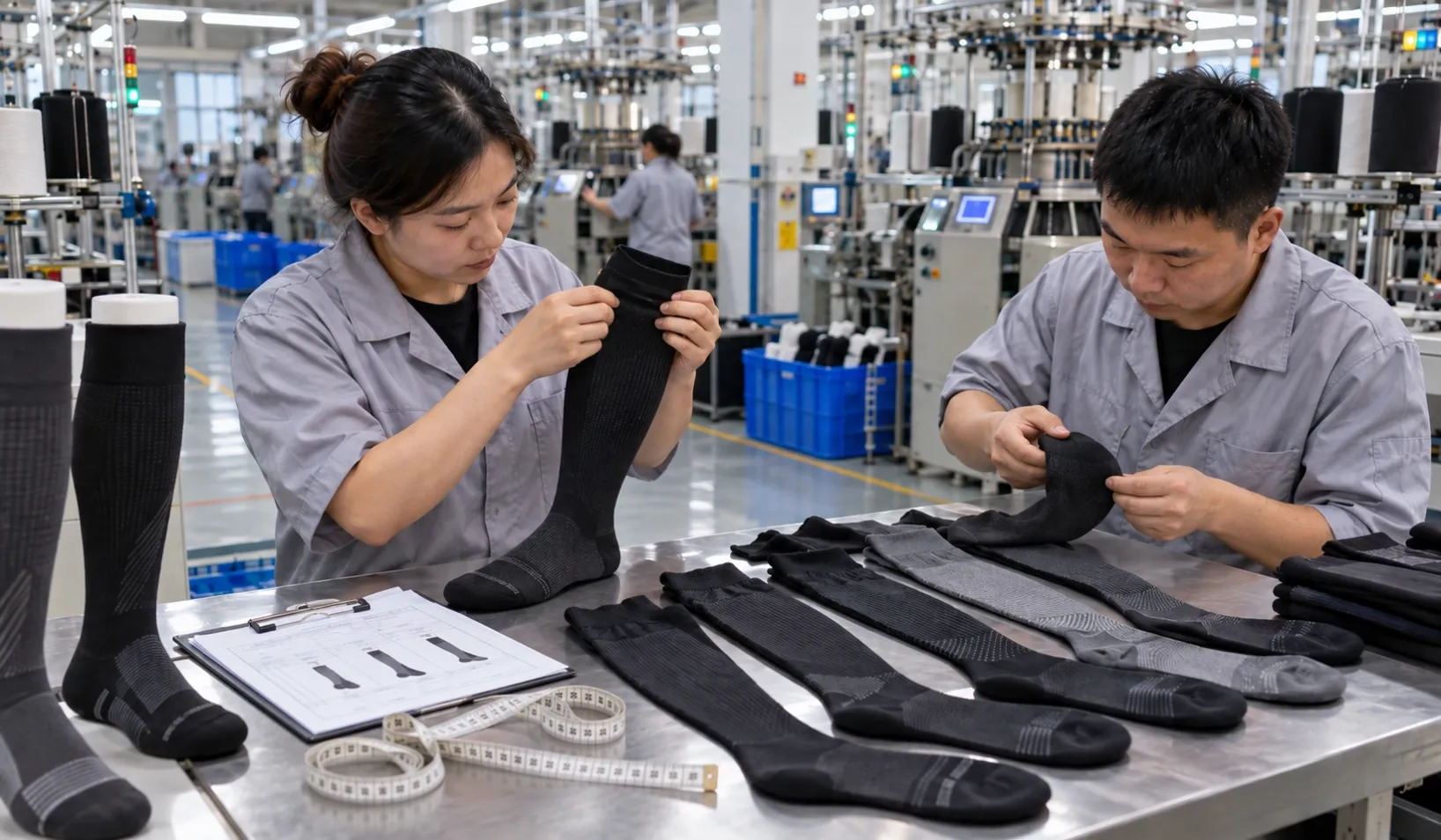
Your Sample Looks Good. Can Your Supplier Repeat It for 10,000 Pairs?
The sample arrives.
The color looks right.
The knitting looks clean.
The fit feels good.
The packaging is acceptable.
Everyone is happy.
So you approve production.
This is where many buyers think the hard part is over.
It is not.
The harder question begins now:
Can the supplier reproduce the same product when the order moves from 3 samples to 3,000 pairs, 10,000 pairs or multiple repeat orders over the next year?
In compression products, the first sample is important.
But repeat-order consistency is what protects your business.
A product can look similar and still change in ways your customer will notice:
the fit feels tighter
the cuff feels looser
the yarn feels rougher
the color shifts
the calf width changes
the compression feel changes
the sock becomes shorter
the packaging looks slightly different
the left and right socks no longer feel identical
One change may look small inside a factory.
But once 5,000 pairs reach the market, a small inconsistency becomes a commercial problem.
If we were evaluating a compression sock supplier for a long-term wholesale program, this is what we would check.
1. A Good Sample Proves the Supplier Can Make One Good Sample
That sounds obvious.
But buyers often give the sample more meaning than it deserves.
A sample proves that, under controlled conditions, the supplier was able to make something close to your requirements.
It does not automatically prove that the supplier has:
stable yarn sourcing
consistent machine settings
clear production specifications
repeatable sizing
batch control
quality records
change-management procedures
or reliable bulk-production capacity
This difference matters.
Sampling is often handled with more attention than normal production.
The best operator may make it.
The yarn may be selected manually.
The sample may be checked several times before it is sent.
Bulk production is different.
Now hundreds or thousands of pairs are being produced across machines, shifts, operators and production days.
That is where the supplier's system matters.
If I Were the Buyer
I would not ask only:
Can you make this sample?
I would ask:
How will you make sure 10,000 pairs match this approved sample?
That question changes the whole conversation.
A supplier that has a real repeat-production system should be able to explain the process clearly.
2. Define What the Approved Sample Actually Approves
This is one of the most overlooked parts of sourcing.
A buyer approves a sample.
But what exactly was approved?
The appearance?
The size?
The yarn?
The color?
The stretch?
The compression level?
The packaging?
The logo position?
If nobody defines this clearly, the approved sample becomes subjective.
Later, when production changes, the supplier may say:
It still looks the same.
And the buyer may say:
It does not feel the same.
Both sides may genuinely believe they are right.
A better approach is to turn the approved sample into a production reference.
This can include:
- material composition
- yarn specification
- product weight
- dimensions
- size tolerances
- knitting structure
- color reference
- compression requirement
- cuff width
- overall length
- heel and toe construction
- logo position
- packaging details
The more important the product is to your business, the more clearly these points should be documented.
3. Yarn Consistency Matters More Than Many Buyers Expect
For compression socks, yarn is not just a raw material.
It directly affects:
fit
stretch
recovery
comfort
surface feel
durability
compression behavior
A factory may use the same general description:
Nylon / Spandex
But the actual yarn source, denier, elastic quality and construction can change the product.
This becomes especially important in repeat orders.
Imagine your first order sells well.
Six months later you place a reorder.
The supplier tells you the original yarn is unavailable and uses a substitute.
The composition may still look similar on paper.
But the finished sock may feel noticeably different.
That is why experienced buyers should ask:
Is the approved yarn specification recorded?
Can repeat orders use the same source?
If not, what is the approval process for substitution?
Will the buyer be informed before any change?
A good supplier should never silently change an important material and hope nobody notices.
4. Control the Size Tolerance Before It Becomes a Return Problem
Compression products are sensitive to sizing.
A few centimeters can affect:
fit
comfort
compression feel
customer satisfaction
If you sell through wholesale or retail channels, inconsistent sizing is especially dangerous because the problem may not appear immediately.
One customer buys size M from the first production.
Another buys size M from the repeat order.
If the second batch feels significantly tighter or longer, the customer does not think:
The knitting tolerance changed.
They think:
The product is inconsistent.
That damages the brand, not the factory.
What should a buyer request?
Ask for measurable size tolerances.
For example:
overall length tolerance
foot length tolerance
cuff width tolerance
ankle width tolerance
calf width tolerance
You do not need unrealistically tight tolerances.
You need realistic tolerances that are defined, measurable and repeatable.
5. Compression Consistency Should Not Depend on Guesswork
This is where compression socks differ from ordinary socks.
The product is not only being judged by appearance.
Its compression behavior matters.
If one batch feels significantly firmer than another, even when both are labeled the same, users may notice immediately.
The production outcome can be affected by:
- yarn
- knitting tension
- machine settings
- dimensions
- elastic recovery
- structure
- finishing
A supplier should therefore have a repeatable way to control the intended specification.
As a buyer, ask:
What production parameters are fixed after sample approval?
How are changes controlled?
What testing or verification is used for the agreed product?
How do you compare repeat orders against the approved reference?
Do not rely only on a label saying 15–20 mmHg or 20–30 mmHg.
The label is the claim.
The production control is what makes the claim repeatable.
6. Color Matching Gets Harder Across Repeat Orders
The first navy order looks perfect.
Six months later, the reorder looks slightly more purple.
To a factory, the difference may seem minor.
To a retailer putting both batches on the same shelf, it is obvious.
Color variation can come from:
different yarn lots
different dye lots
supplier changes
lighting during approval
production timing
material differences
This is why the buyer should define a reference.
Depending on the project, this can be:
an approved physical sample
a lab dip
a Pantone reference
a yarn color card
or another agreed standard
For repeat orders, the supplier should compare against the approved reference rather than relying on memory.
Memory is not a quality-control system.
7. The Bigger the Order, the More Important Process Control Becomes
A 500-pair trial order and a 20,000-pair production order are not the same manufacturing challenge.
As volume increases, more variables appear.
More machines may be used.
More operators may be involved.
More yarn lots may be required.
Production may run across more days.
Packaging may be handled by more people.
This is why buyers should not ask only:
Can you produce 20,000 pairs?
Almost every supplier will say yes.
A better question is:
How will you control consistency across the full production run?
That answer tells you much more.
A good supplier should be able to explain:
how production is divided
how approved specifications are communicated
how inline checks are performed
how size and appearance are checked
how defects are handled
how packing is controlled
how final inspection works
8. Ask What Happens When Something Changes
This is one of the best questions an experienced buyer can ask.
Because something will eventually change.
Maybe:
the yarn supplier changes
a machine becomes unavailable
packaging material is delayed
a color is discontinued
the order volume suddenly increases
the original production window changes
The question is not whether changes happen.
They do.
The real question is:
How does the supplier manage the change?
A strong supplier should tell you before the change affects production.
A weak supplier may make the change first and explain later.
That difference is enormous.
Questions to ask
If the approved material becomes unavailable, what happens?
Will you send a replacement option for approval?
Do you keep records from previous orders?
Can you reproduce the previous specification?
Who approves production changes internally?
Who informs the buyer?
These questions reveal whether you are dealing with a factory that simply produces orders or a supplier that manages programs.
9. Repeat Orders Should Become Easier, Not Harder
One good sign of a reliable supplier is that repeat orders become smoother over time.
The first order may involve many questions.
That is normal.
But by the third or fourth order, the supplier should already understand:
your sizing
your packaging
your labels
your color standards
your carton requirements
your preferred communication style
your inspection expectations
your delivery pattern
If every repeat order feels like starting from zero, something is wrong.
Your supplier should be building knowledge around your account.
That knowledge has commercial value.
It reduces mistakes.
It saves time.
It improves speed.
It makes future development easier.
This is one reason experienced buyers often value a stable supplier relationship.
Changing suppliers may save money.
But it also resets a large amount of accumulated knowledge.
10. The Cheapest Reorder Can Become the Most Expensive
Imagine your first supplier charges USD 3.00.
A new supplier offers USD 2.82.
You save USD 0.18 per pair.
On 10,000 pairs, that is USD 1,800.
That saving looks attractive.
But now imagine:
the sizing shifts
the yarn feels different
the color is slightly wrong
delivery is delayed by two weeks
or 300 pairs require rework
The USD 1,800 disappears quickly.
This does not mean you should never move to a lower-cost supplier.
It means the buyer should compare the full cost of transition.
A supplier change should make commercial sense after including:
sample development
testing
approval time
internal communication
inventory overlap
quality risk
delivery risk
customer reaction
Sometimes changing suppliers is absolutely the right decision.
But the decision should be based on total value, not only unit price.
11. Ask for Evidence of Process, Not Promises
Every supplier can say:
We control quality strictly.
We ensure stable production.
We have professional QC.
Those statements mean very little by themselves.
Ask what the process looks like.
Useful evidence may include:
production specification sheets
sample approval records
dimension records
inspection forms
material confirmation
packaging checklists
batch records
final inspection reports
third-party inspection support
The exact documents will vary by supplier and project.
The point is simple.
You are not looking for a perfect factory.
You are looking for a repeatable process.
12. Build a Repeat-Order Checklist
Before placing a reorder, compare the new order against the previous approved version.
A simple checklist might include:
Item | Previous Order | New Order |
|---|---|---|
Yarn | | |
Material Composition | | |
Compression Requirement | | |
Size Specification | | |
Color Reference | | |
Logo | | |
Packaging | | |
Label | | |
Carton Requirement | | |
QC Requirement | | |
Lead Time | | |
Shipping Term | | |
This does not need to be complicated.
Even a one-page repeat-order confirmation can prevent many expensive misunderstandings.
If You Are an Experienced Buyer
You probably already know that the most dangerous order is not always the first one.
Sometimes the first order gets maximum attention.
Then the second order is treated as routine.
That is exactly when problems begin.
For repeat orders, we recommend confirming at least:
material
yarn
size
compression
color
packaging
production quantity
lead time
inspection requirement
before production starts.
Even if nothing changes, confirm that nothing changes.
That sentence sounds boring.
But boring systems are often what keep wholesale programs profitable.
If This Is Your First Private Label Order
You do not need to create a complicated quality system.
Start with one simple rule:
Keep one approved reference for everything important.
Keep:
one approved product sample
one approved size chart
one approved color reference
one approved packaging file
one approved label file
Then ask your supplier to use these references for bulk production.
When the next order comes, compare the new production against the same references.
You do not need to understand every technical detail.
You just need a clear baseline.
13. Ten Questions to Ask Before You Place a Large Repeat Order
- Will the repeat order use the same yarn as the approved order?
- Has any material source changed?
- Are the same size specifications being used?
- Has the knitting structure changed?
- Will the same compression specification be followed?
- Are the same color references being used?
- Has the packaging material changed?
- What production quantity will run on each machine or batch?
- What inline and final inspections will be performed?
- If something changes before production, how will I be informed?
These questions take a few minutes.
The problems they prevent can cost weeks.
What Should a Good Supplier Do Before a Repeat Order?
A reliable supplier should not treat a reorder as:
Same as last time. Please pay deposit.
They should confirm:
what stays the same
what changes
what materials are being used
what production schedule applies
what inspection standard applies
and whether any previous issue needs improvement
This is particularly important if months have passed since the last order.
Factories change.
Raw materials change.
People change.
Machines change.
The specification should not depend on someone's memory of what happened six months ago.
How Aby-Tex Approaches Repeat-Order Consistency
At Aby-Tex, we view repeat orders differently from one-time production.
A successful product is not only one that looks good during development.
It is one that can be reproduced with stable specifications when the customer comes back for the next order.
For compression socks and knitted support products, we focus on controlling the agreed points that matter most to repeatability, including material, yarn recovery, knitting density, sizing, construction, compression distribution, appearance and packaging requirements.
For established programs, customers can provide an approved sample or existing specification for comparison.
For new programs, we can help define the product specification during sampling so that the approved version becomes a clearer production reference for future orders.
The goal is simple:
The second order should not surprise you.
FAQ
Why can repeat orders feel different even when the specification looks the same?
Differences may come from yarn lots, knitting tension, machine settings, material substitutions, size tolerances, finishing or color variation. This is why production references and change control matter.
Should I keep an approved physical sample?
Yes. For many buyers, an approved physical sample is useful as a reference for appearance, fit, construction and general workmanship. It should ideally be supported by written specifications.
Can a supplier guarantee every pair is identical?
No manufacturing process produces zero variation. The important issue is whether variation stays within agreed and commercially acceptable tolerances.
What should I check first on a repeat order?
Confirm material, yarn, size, color, compression requirement, packaging and lead time. Also ask whether anything has changed since the previous order.
Why does yarn consistency matter for compression socks?
Yarn affects elasticity, recovery, fit, comfort and compression behavior. A material substitution can change how the final product feels and performs.
Should I change suppliers if the new quotation is cheaper?
Possibly. But compare total transition risk, including sampling, approval, quality, delivery and repeat-order stability, not just the unit price.
Before You Place Your Next Repeat Order
Take your last approved product.
Put it next to the new order specification.
Then ask one question:
What has changed?
If the answer is nothing, make sure the supplier can prove that the same key specifications are being used.
If something has changed, understand the impact before production starts.
Because the goal of a repeat order is not to make the product again.
It is to make the same product again.
Have an existing compression sock you want to reproduce or improve?
Send Aby-Tex your current sample, specification and order requirements. We can review the product structure, sizing, materials and repeat-order requirements before sampling or bulk production.