
Oct 1, 2026Market & Industry Insights
How to Compare Compression Sock Quotations
Comparing compression sock prices? Learn what experienced buyers check beyond unit price, including yarn, compression, sizing, MOQ, packaging, QC and repeat-order consistency.
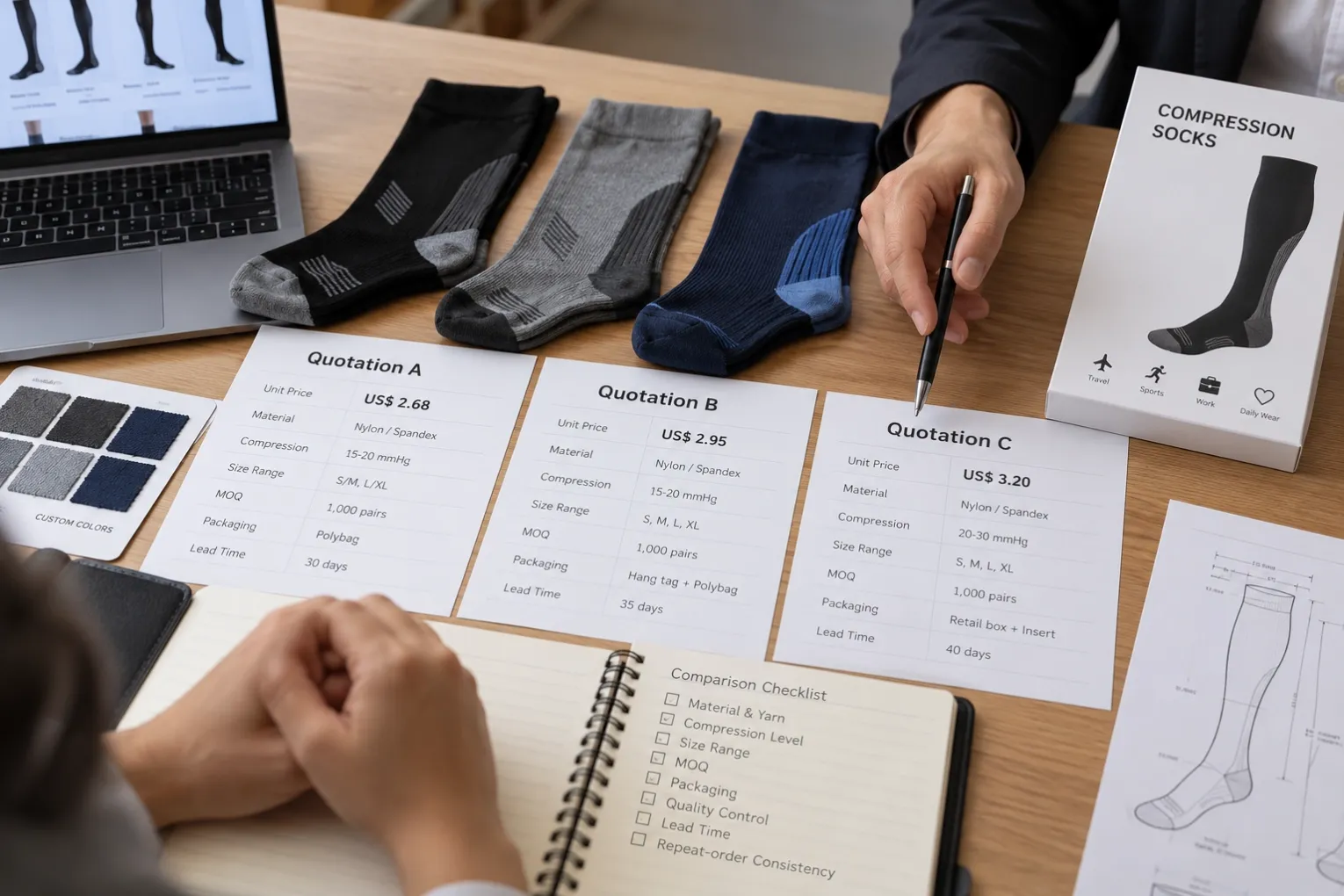
How to Compare Compression Sock Quotations Without Comparing the Wrong Product
You receive three quotations for what appears to be the same compression sock.
Supplier A: USD 2.68.
Supplier B: USD 2.95.
Supplier C: USD 3.20.
The obvious question is:
Why should I pay USD 3.20 when another supplier can make it for USD 2.68?
That is a reasonable question.
But experienced buyers know that the more important question is:
Are all three suppliers actually quoting the same product?
With knitted compression products, two socks can look almost identical in a photograph while being very different in yarn quality, compression construction, sizing, weight, elasticity, finishing and production consistency.
A cheaper quotation may genuinely come from a more efficient supply chain.
Or it may simply be quoting a different product.
Before negotiating the last USD 0.10, make sure you know which one you are dealing with.
This guide shows the points we would check if we were comparing compression sock suppliers for our own wholesale or private-label program.
1. Start With One Rule: Compare Specifications Before Prices
One of the most common mistakes in sourcing is sending a product photo to several manufacturers and asking:
Please quote your best price.
You may receive five prices.
But you probably do not have five comparable quotations.
A photograph does not tell the manufacturer everything they need to know.
It may not define:
- yarn composition
- yarn quality
- compression level
- compression distribution
- sock weight
- knitting density
- size range
- cuff construction
- toe construction
- heel structure
- logo method
- packaging
- testing requirements
- order quantity per color and size
Every supplier will fill those missing details with its own assumptions.
That means Supplier A may be quoting a lighter construction while Supplier B is quoting a denser sock.
Supplier C may include custom packaging while Supplier A does not.
One factory may quote the compression structure you requested. Another may quote something that simply feels tight.
The prices are different because the products are different.
What I would ask the supplier
Before comparing prices, ask each supplier to confirm the quotation against the same specification sheet.
At minimum, confirm:
Product type
Knee-high, thigh-high, sleeve, open-toe, zippered or conventional.
Compression requirement
For example, 15–20 mmHg or 20–30 mmHg, together with how the supplier defines and verifies it.
Material composition
Not simply nylon and spandex. Ask for the proposed blend and yarn option.
Size range
Including the actual measurement logic behind each size.
Color quantity
Logo method
Packaging
Order quantity
Testing or inspection requirements
Once these are fixed, price comparison starts to mean something.
2. Ask What Changed to Achieve the Lower Price
Suppose Supplier A quotes USD 2.70 and Supplier B quotes USD 3.05.
Do not immediately ask Supplier B:
Can you match USD 2.70?
Ask this first:
What would need to change in this specification to reach USD 2.70?
That question is far more useful.
A competent supplier should be able to explain the cost structure rather than simply offering a mysterious discount.
The difference might come from:
- a different yarn
- lower product weight
- simpler knitting construction
- fewer colors
- simpler packaging
- different order quantity
- different logo technique
- reduced customization
- different inspection requirements
Some changes may have almost no impact on the customer experience.
Others may completely change the product.
Your job as the buyer is not necessarily to choose the most expensive specification.
Your job is to know what you are giving up for the saving.
If I Were the Buyer
If I could save USD 0.12 per pair by simplifying an unnecessary packaging detail, I would consider it.
If I could save USD 0.12 only by changing the yarn or construction that controls fit and recovery, I would think much harder.
Both decisions save USD 1,200 on a 10,000-pair order.
But they do not carry the same commercial risk.
This is why good sourcing is rarely about asking:
How can I make this cheaper?
A better question is:
Where can I reduce cost without damaging the part of the product my customer actually values?
3. Compare Yarn and Elastic Recovery, Not Just Material Names
A quotation saying:
80% nylon / 20% spandex
does not automatically mean it is equivalent to another quotation with the same composition.
Material percentages tell you part of the story.
They do not tell you everything about:
- yarn specification
- elastic recovery
- knitting density
- hand feel
- stretch behavior
- durability after repeated wear
- production consistency
This matters particularly in compression products because elasticity is part of the product structure.
A sock that feels acceptable when new may behave differently after repeated stretching and washing if the yarn and construction are poorly matched.
What should a buyer ask?
Ask the supplier:
- What yarn construction are you proposing?
- Is this the same yarn intended for bulk production?
- If the yarn source changes, how will I be informed?
- How do you control elasticity between production batches?
- Can repeat orders use the same approved material specification?
You do not need to become a textile engineer.
You simply need enough information to know what you are actually buying.
4. Never Compare Compression Level by Label Alone
Two products can both be described as 15–20 mmHg.
That does not mean they will automatically perform or feel identical.
Compression products depend on a combination of yarn, knitting structure, dimensions, stretch and pressure distribution.
For an experienced buyer, the question should therefore not stop at:
Can you make 15–20 mmHg?
Ask:
How are you producing and controlling the requested compression specification?
Then ask what evidence can be provided for the product you are actually developing.
The wording matters.
Do not assume a generic report, an old laboratory result or a report from another construction automatically represents your order.
For every technical or compliance-related claim, confirm what applies to your specific product, market and batch.
5. Compare the Size System Before You Compare the Price
Sizing causes more commercial problems than many buyers expect.
Imagine this situation.
Supplier A offers:
S/M
L/XL
Supplier B offers:
S
M
L
XL
Supplier A looks cheaper.
But that does not automatically make Supplier A the better commercial choice.
The real questions are:
Who is your customer?
How broad is the calf circumference range?
How much tolerance does your sales channel accept?
How many SKUs can your inventory support?
How costly are size-related returns or complaints?
More sizes may improve fit but increase inventory complexity.
Fewer sizes may simplify inventory but create a broader fit range.
Neither is automatically correct.
What I would ask the supplier
Ask for the proposed sizing chart before confirming the quotation.
Then check:
- ankle circumference
- calf circumference
- leg length
- foot size where relevant
- measurement tolerances
- largest and smallest intended users
If you already sell compression socks, give your supplier your existing sizing system.
If the current sizing works well, changing it just to save a few cents may create problems that are much more expensive later.
6. Check Whether the Price Includes the Same Packaging
Packaging is one of the easiest places for quotations to become misleading.
One supplier may quote:
sock + polybag
Another may quote:
sock + printed insert + retail box + barcode label + master carton requirements
The second quotation is obviously higher.
But it may actually be the more complete quotation.
Before comparing unit prices, separate the costs.
Ask for something like:
Product: USD X.XX
Logo/customization: USD X.XX
Retail packaging: USD X.XX
Special labeling: USD X.XX
Other one-time cost: USD X.XX
Now you can see where the difference really comes from.
This is especially useful for wholesalers or importers supplying different customers.
You may discover that the same core sock can serve multiple programs simply by changing packaging.
That can be much smarter than creating a completely new product for every customer.
7. Look at MOQ by SKU, Not Just Total MOQ
A supplier tells you:
MOQ is 1,000 pairs.
Sounds simple.
But 1,000 pairs of what?
One color?
One design?
One size?
One yarn?
One packaging version?
Or can 1,000 pairs be divided across several sizes?
This matters enormously.
For a wholesaler, a nominally low MOQ may still create poor inventory economics if the supplier requires large quantities for every individual SKU.
For example:
1,000 pairs × 4 colors × 4 sizes
is very different from:
1,000 pairs total, distributed across an agreed size ratio.
Do not compare MOQ as one number.
Ask the supplier to explain the MOQ structure.
A better buyer question
Instead of:
What is your MOQ?
Ask:
If I want three colors and four sizes, how would you structure the minimum production quantity?
That question gives you information you can actually use.
8. Price the First Order and the Repeat Order Separately
This is where experienced buyers should pay particular attention.
Many suppliers can produce one good sample.
Many can also produce one acceptable first order.
The harder question is:
Can they reproduce it six months later?
If a product becomes successful, repeat-order consistency matters more than an impressive first sample.
You want the second batch to maintain the agreed:
- yarn
- size
- construction
- compression specification
- color
- logo
- packaging
- workmanship
This is where good specification control becomes important.
Ask:
What exactly becomes the approved production reference?
How are changes documented?
What happens if the original yarn is unavailable?
Who approves substitutions?
Will the supplier inform you before changing material or construction?
A USD 0.10 saving on the first order becomes irrelevant if the second order no longer matches the product your customers already know.
9. Compare Lead Time as a Process, Not One Number
A quotation may say:
Lead time: 30 days.
Another says:
Lead time: 40 days.
The first looks better.
But what exactly does 30 days mean?
From deposit?
From sample approval?
From packaging approval?
From material arrival?
And does that include final inspection and packing?
Good production planning separates the timeline.
For example:
- specification confirmation
- material preparation
- sampling
- buyer review and revision
- packaging approval
- bulk production
- finishing and inspection
- packing
- shipment
That is much more useful than receiving one optimistic number.
If I Were the Buyer
I would rather work with a supplier that gives me a realistic 35-day production plan and delivers consistently than one that promises 25 days every time and ships in 40.
For wholesalers and distributors, predictability often creates more value than speed.
Your customer does not care that your supplier promised you a short lead time.
Your customer cares whether the goods arrive when you promised them.
10. Ask What Quality Control Is Included in the Quotation
Do not assume every supplier means the same thing when they say:
QC included.
Ask what is actually checked.
Depending on the product and your requirements, relevant controls may include:
- incoming material confirmation
- pre-production sample approval
- dimensions
- knitting workmanship
- appearance
- color
- closures or accessories
- labels
- packaging
- final inspection
- agreed technical tests
Most importantly, ask what records are available.
A statement saying:
Quality checked before shipment
is less useful than an actual inspection record tied to the product or lot.
For larger orders or higher-risk programs, you can also discuss independent inspection or testing where appropriate.
The level of inspection should match the commercial risk of the order.
11. Calculate the Cost of a Supplier Problem, Not Just the Cost of the Sock
Suppose one supplier saves you USD 0.15 per pair.
On 5,000 pairs, you save USD 750.
Good.
Now imagine the order arrives late and your retailer postpones a promotion.
Or sizing inconsistency creates 150 returns.
Or a repeat order uses a noticeably different yarn.
Or the packaging artwork was not checked and 5,000 units need relabeling.
Suddenly the USD 750 saving is irrelevant.
This does not mean you should always choose the highest price.
It means unit price is only one part of procurement cost.
A more complete sourcing calculation includes:
Product cost
plus
quality risk
plus
inventory risk
plus
delay risk
plus
communication cost
plus
cost of correcting mistakes
This is why reliable suppliers sometimes survive for years even when they are not the cheapest quotation on the buyer's desk.
They remove uncertainty.
And uncertainty is expensive.
12. A Simple Compression Sock Quotation Comparison Sheet
If you are comparing three suppliers, build a table like this.
Item | Supplier A | Supplier B | Supplier C |
|---|---|---|---|
Unit Price | | | |
Compression Specification | | | |
Material / Yarn | | | |
Knitting Construction | | | |
Size Range | | | |
MOQ per SKU | | | |
Logo Included | | | |
Packaging Included | | | |
Sample Cost | | | |
Sample Lead Time | | | |
Bulk Lead Time | | | |
QC Process | | | |
Testing / Inspection Options | | | |
Repeat-Order Specification Control | | | |
Payment Terms | | | |
Shipping Term | | | |
Only after filling in this table should you put the three unit prices next to each other.
You may still choose the cheapest supplier.
That is perfectly fine.
But now you know why it is cheaper.
If You Are an Experienced Buyer
You probably do not need a supplier to explain what private labeling means.
Your priorities are likely much simpler:
Can you reproduce my current product?
Can you improve my landed cost without damaging the specification?
Can you keep repeat orders consistent?
Can you meet the delivery window?
Can you solve a problem quickly when something goes wrong?
In that situation, send the supplier:
- current product photos
- specification sheet
- physical reference sample if available
- target quantity
- current size ratio
- packaging requirement
- target market
- target price if appropriate
- specific problems with your current product
The more precise the input, the more meaningful the quotation.
If This Is Your First Compression Sock Order
You do not need to have everything prepared.
A capable supplier should help you turn a rough idea into a manufacturable specification.
Start with five things:
Step 1 — Tell the supplier who you want to sell to
For example:
travel customers
sports users
retail pharmacies
general wellness
workwear customers
online consumers
Step 2 — Send a reference product
It can be:
a competitor link
a photograph
a physical sample
or simply a product style you like.
You are not saying you want to copy it.
You are giving the supplier a starting point.
Step 3 — Give your approximate quantity
Even a range is useful.
For example:
1,000–2,000 pairs for the first trial.
This helps the supplier recommend a realistic construction and customization plan.
Step 4 — Explain your price position
You do not always need to disclose your exact target buying price.
But the supplier should understand whether you are building:
an entry-level product
a mainstream retail product
or a premium product.
Otherwise, they may develop something technically impressive that makes no commercial sense for your market.
Step 5 — Let the supplier help build the first specification
The first discussion should help define:
material
compression
size range
colors
logo
packaging
MOQ
sampling
and estimated production timing.
Then sample.
Do not try to solve every question before contacting the factory.
That is what the development process is for.
13. Ten Questions to Send to a Compression Sock Supplier
You can copy these questions directly into your next RFQ.
- What exact product specification is your quotation based on?
- Which material or yarn option are you proposing?
- How is the requested compression specification controlled?
- What sizing system do you recommend for my target market?
- How is your MOQ calculated across sizes and colors?
- Which packaging items are included in the quoted price?
- What factors could reduce the price without materially changing product performance?
- What is your sampling and bulk-production timeline?
- How do you control repeat-order consistency?
- What inspection or testing records can be provided for my order?
A supplier's answers to these questions will often tell you more than another round of price negotiation.
What Should a Good Supplier Do During Quotation?
A good supplier should not simply receive your photo, send you a price and wait for the deposit.
They should identify missing information.
They should ask questions.
They should explain which specifications influence price.
They should tell you when two requirements conflict.
They should help simplify a product if your budget does not support the original specification.
And when they do not know something, they should say so rather than invent an answer.
The purpose of a quotation is not simply to produce a number.
It is to make sure both parties are pricing the same product.
How Aby-Tex Supports Quotation and Product Development
At Aby-Tex, we work with brands, importers and wholesalers developing knitted sports supports and compression products.
If you already have an established compression sock program, you can send us your existing product specification or reference sample and ask us to review the construction, customization requirements and order structure.
If this is your first project, you can start with something much simpler:
- your target customer
- a reference product
- your estimated quantity
- your intended price position
From there, we can discuss material, compression construction, sizing, branding, packaging and sampling before you commit to bulk production.
The objective is not simply to send you the lowest number.
It is to make sure the quotation describes the product you actually intend to buy.
FAQ
Why do compression sock quotations vary so much?
Different suppliers may be quoting different yarns, knitting constructions, product weights, size systems, packaging, customization or QC requirements. Confirm the specification before comparing unit prices.
Should I always choose the lowest quotation?
Not necessarily. A lower quotation can be a perfectly good choice if the specification is equivalent and the supplier can meet your quality and delivery requirements. The important thing is understanding where the cost difference comes from.
What information should I send for an accurate quotation?
Ideally send your product specification, target compression requirement, material preference, size range, colors, branding, packaging, quantity and target market. A physical sample or reference product can also help.
Can I request a quotation if I do not have a tech pack?
Yes. For an early-stage project, you can begin with a product reference, target user, estimated quantity and price positioning. The supplier can then help define the specifications needed for sampling.
How should wholesalers compare MOQs?
Ask how the minimum quantity is divided across colors, sizes, designs and packaging versions. A low total MOQ may still create a large inventory requirement if each SKU carries its own minimum.
What is more important: price or repeat-order consistency?
Both matter. The right balance depends on your sales channel and margin. For repeat wholesale programs, however, changes in fit, material, color or construction can create costs far greater than a small difference in unit price.
Before You Approve the Next Quotation
Do one simple thing.
Take the cheapest quotation and the most expensive quotation on your desk.
Put the prices aside.
Compare:
the yarn,
the compression specification,
the construction,
the sizing,
the MOQ structure,
the packaging,
the quality controls,
and the repeat-order plan.
If they are truly the same product, then negotiate the price.
If they are not, you were never comparing prices in the first place.
You were comparing different products.
Have a compression sock specification or reference sample you want us to review?
Send Aby-Tex your product requirements, target market and estimated quantity. We can help clarify the specification, customization options and sampling route before bulk production.