Oct 9, 2026Market & Industry Insights
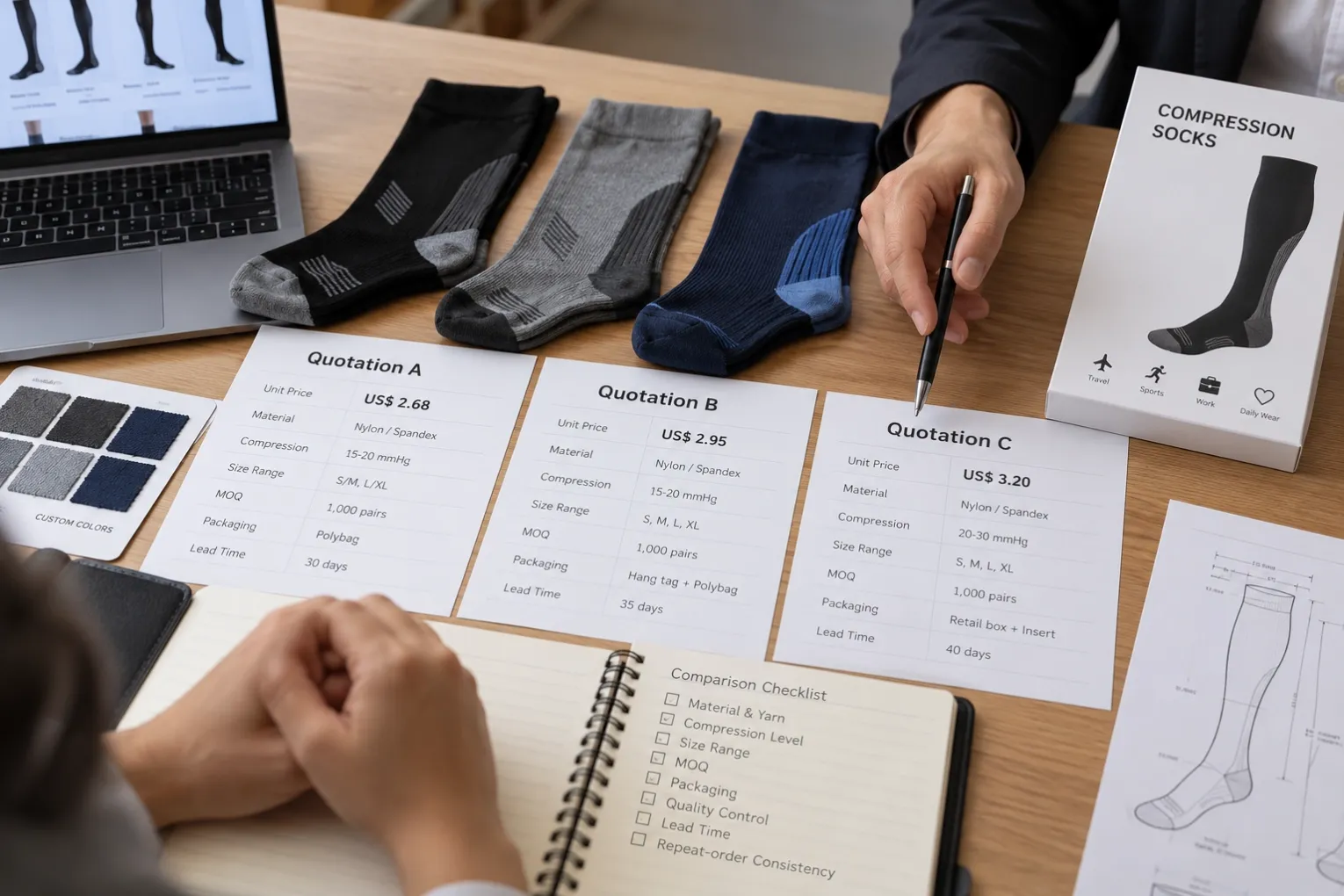
Switching Compression Sock Suppliers? 8 Things to Check
Thinking about changing compression sock suppliers? Check product specs, yarn, sizing, lead time, MOQ and trial order risk before moving production.
Changing suppliers sounds simple.
The new factory offers a better price, faster lead time or lower MOQ, so you move the order.
But if the product is already selling, switching suppliers is not just a purchasing decision.
You are also protecting an existing product.
The real question is not:
Can the new supplier make compression socks?
It is:
Can they make your product without creating new problems?
Here are eight things worth checking before you move an established order.
1. Start With the Existing Product
Do not send only a photo and ask for a cheaper quotation.
Send as much of the current product information as possible:
- physical sample
- size chart
- material composition
- compression requirement
- packaging
- order quantity
- color reference
The new supplier needs to understand what they are replacing before they can quote properly.
2. Ask What Will Be Different
A useful supplier should be able to tell you where their version may differ.
Maybe the yarn is different.
Maybe the cuff construction is different.
Maybe your current size range is wider than their standard.
That is useful information.
A supplier that simply says yes, same product, no problem without asking questions is not necessarily giving you confidence.
Ask:
If you make this product with your current production setup, what will be different?
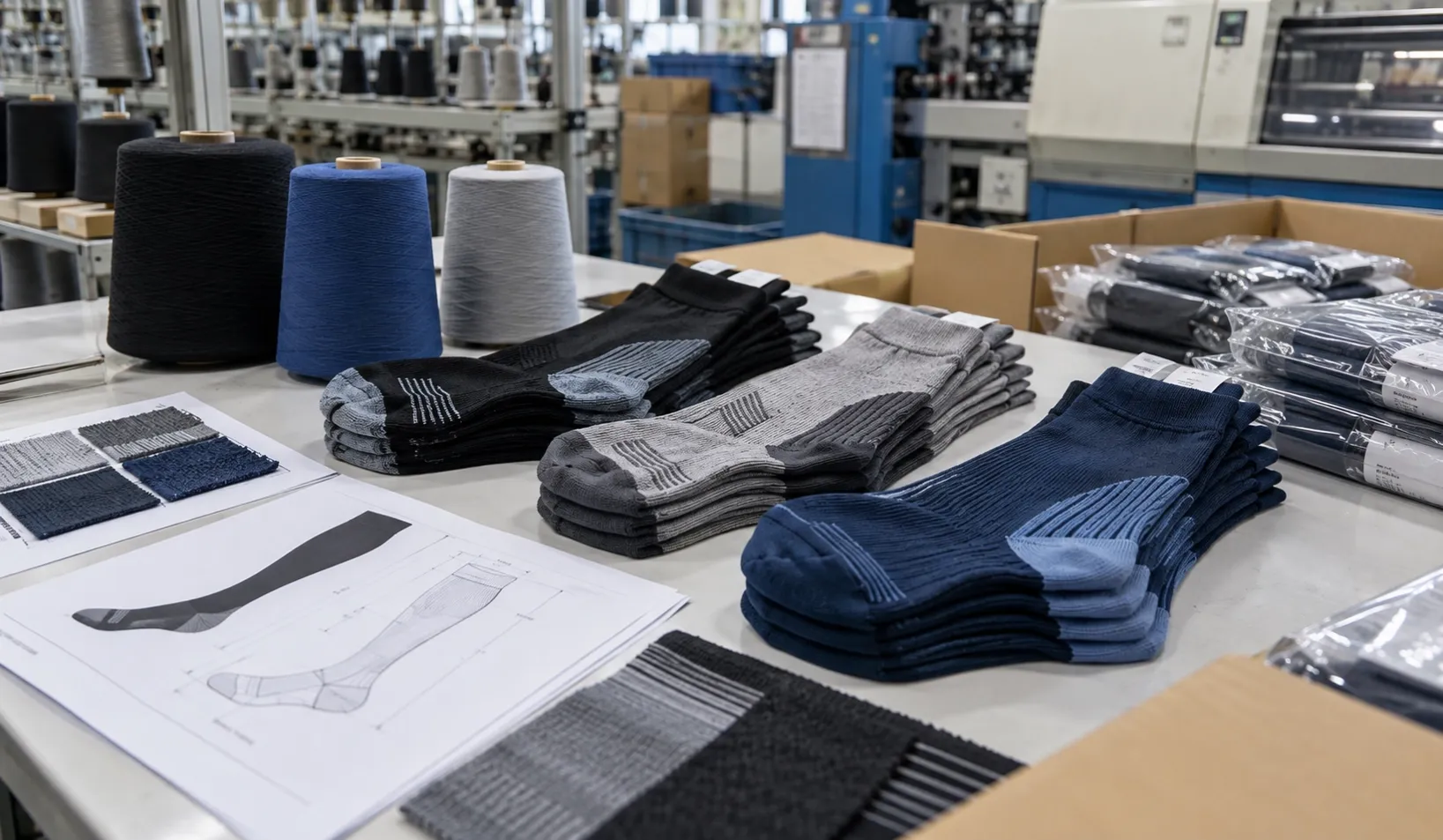
3. Compare the Yarn, Not Just the Composition
Two socks can both say nylon and spandex and still feel different.
Yarn affects:
- hand feel
- stretch
- recovery
- weight
- durability
If the current product already sells well, do not change yarn casually just to save a few cents.
Ask for a side-by-side sample.
4. Keep the Size Logic
S, M, L and XL mean very little by themselves.
Check the actual measurements:
- ankle
- calf
- length
- foot size
- tolerance
If your current sizing already works well, the new supplier should try to reproduce that fit instead of simply using their own standard chart.
5. Compare Compression Feel Side by Side
The same labeled compression range does not always mean the socks will feel the same.
Compare your current product with the new sample directly.
Check:
- ease of putting on
- ankle pressure
- calf fit
- cuff comfort
- recovery after stretching
If the product feels different, understand why before approving bulk production.
6. Look at the Real MOQ and Lead Time
A lower unit price may come with:
- higher MOQ per color
- higher MOQ per size
- longer yarn preparation
- longer packaging lead time
Ask for the actual order structure.
A supplier saying MOQ 1,000 pairs is not enough.
You need to know how those 1,000 pairs can be divided.
The same goes for lead time.
Ask when the clock actually starts and what the quoted production time includes.
7. Start With a Trial Order
This is probably the safest way to switch suppliers.
Do not move the full annual volume just because the sample looks good.
A better approach is:
sample first
small order second
larger order after the supplier proves they can deliver consistently
If I were buying 50,000 pairs a year, I would rather test 2,000 pairs first than discover a problem after moving the full program.
8. Keep the Old Supplier Until the New One Is Proven
If possible, do not close the old supply route immediately.
Keeping both suppliers active for a short period gives you:
- backup capacity
- comparison data
- lower supply risk
- more time to evaluate the new source
Once the new supplier proves quality, delivery and repeat-order consistency, then you can decide how much volume to move.
A Simple Supplier Switch Checklist
Before moving an order, compare:
Item | Current Supplier | New Supplier |
|---|---|---|
Price | | |
Yarn | | |
Size | | |
Compression | | |
MOQ | | |
Lead Time | | |
Packaging | | |
QC Process | | |
Trial Order Result | | |
The point is simple.
Do not let one attractive unit price make the whole decision for you.
If I Were the Buyer
I would not ask only:
How much cheaper are you?
I would ask:
What changes if I move this product to you?
If the important specifications stay stable and the commercial terms improve, the switch may make sense.
If the yarn, fit, compression, MOQ and lead time all change, then you are not just changing suppliers.
You are changing the product.
How Aby-Tex Can Help
If you already have a compression sock program and are considering another supplier, you can send Aby-Tex:
- your current sample
- size chart
- target quantity
- packaging
- the problem you want to improve
We can review the product first and help identify which parts should stay unchanged and which parts may be optimized before sampling.
The goal is not simply to move the order.
The goal is to make the move worth it.