Oct 26, 2026Product Knowledge
Back Support Belt Materials: Knitted Fabric, Mesh and Elastic Straps Explained
Compare knitted fabric, breathable mesh and elastic straps for back support belts. Learn what OEM buyers should check before sampling and production.
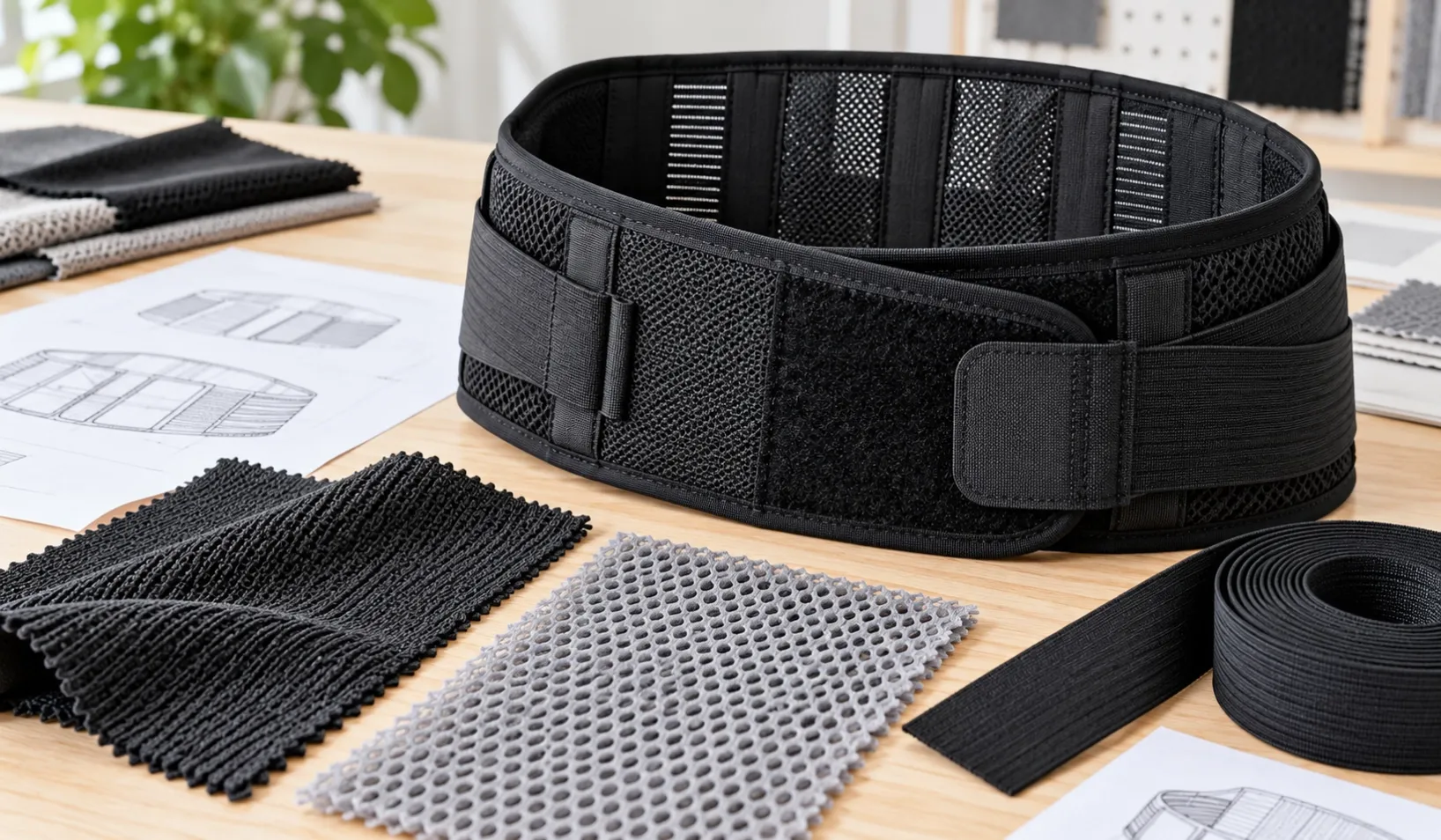
Two back support belts can look almost identical in a supplier's catalog.
Both are black. Both have adjustable straps. Both are described as breathable and comfortable.
Yet one may feel noticeably warmer, stretch differently or fit more smoothly around the waist.
For brands and wholesalers, these differences often come down to material selection and construction.
Before comparing quotations, it helps to understand what each material actually contributes to the finished product.
1. Why Material Selection Matters
A back support belt is rarely made from just one material.
Depending on the design, it may combine knitted fabric, mesh, elastic straps, hook-and-loop fasteners and flexible support stays.
Each component serves a different purpose.
For example, the main body fabric influences fit and wearing comfort, while the fastening system determines how the belt is adjusted.
The construction should be selected around the intended wearer, product positioning and expected use.
Simply requesting a breathable back brace is not enough to define the product.
2. Knitted Fabric: Flexibility and Fit
Elastic knitted fabrics are commonly used in support products because they can provide different stretch and recovery characteristics.
For back support belts, material development may involve nylon, polyester, spandex and other yarn combinations.
However, fiber composition alone does not determine how a fabric will behave.
Knitting structure, fabric weight, finishing and elastic yarn specifications also matter.
When reviewing knitted fabric samples, buyers should consider:
- Stretch in different directions
- Elastic recovery after repeated use
- Fabric thickness and surface texture
- Edge comfort against the body
- Dimensional stability after washing
A fabric that feels soft during the first fitting should also be evaluated after repeated stretching and laundering.
This is particularly important for products intended for regular use.
3. Mesh Panels: Managing Heat and Fabric Bulk
Breathable mesh is another common material option.
Mesh construction contains openings that can allow greater airflow than some dense fabric constructions.
However, not all mesh materials have the same structure, stretch or durability.
Some mesh fabrics are knitted, so mesh and knitted fabric are not necessarily opposite material categories.
For buyers, the important questions are practical.
How open is the mesh structure?
Does it stretch enough for the intended design?
Will it maintain acceptable stability when connected to elastic straps or reinforcement panels?
Can it withstand the expected washing and wearing conditions?
Buyer tip: Compare complete samples, not just fabric swatches. A breathable panel may perform differently once it is combined with additional layers, binding and support components.
4. Elastic Straps: Adjustment and Recovery
Elastic straps play an important role in many adjustable lumbar support designs.
They allow the wearer to change the fastening tension and fit within an intended adjustment range.
But elastic straps should not be evaluated by stretch alone.
Buyers should check their recovery, edge construction, attachment method and behavior after repeated use.
A strap that stretches easily but loses recovery too quickly may affect the finished product's fit.
For dual-strap designs, the relationship between the main belt and secondary adjustment straps also deserves attention.
During sampling, confirm that the straps can be adjusted without excessive twisting or bunching.
5. What About Support Stays and Reinforcement Panels?
Some back support belts include flexible stays or reinforcement elements.
These components can change the structure and feel of the product.
The appropriate design depends on the intended application.
Buyers should specify:
- The number and position of reinforcement elements
- Their material and flexibility
- How they are secured to the fabric
- Whether edges or ends create uncomfortable contact points
- How the finished belt behaves during movement
Do not assume that adding more stays automatically creates a better product.
Any claimed stabilization or therapeutic performance should be evaluated using evidence appropriate to the intended product.
6. How to Compare Material Options Before Sampling
When comparing back support belt constructions, use consistent evaluation criteria.
Material or Component | Main Evaluation Points |
|---|---|
Elastic knitted fabric | Stretch, recovery, thickness and fit |
Mesh panels | Airflow, flexibility and durability |
Elastic adjustment straps | Recovery, tension range and attachment |
Hook-and-loop closures | Fastening performance and repeated use |
Support stays | Placement, flexibility and secure assembly |
These are evaluation criteria rather than guaranteed material benefits.
The best choice depends on the target product and its intended use.
7. Material Choices Also Affect Cost
For private-label buyers, material selection is a commercial decision as well as a technical one.
Two quotations may differ because of fabric specifications, reinforcement construction, fastening components or manufacturing complexity.
Before comparing prices, confirm that suppliers are quoting the same product requirements.
A useful quotation should identify the agreed material specifications, dimensions, construction details, customization requirements and packaging.
Otherwise, the cheaper option may simply be a different product.
For initial development, prioritize a practical material specification that can be reproduced consistently across repeat orders.
8. What Should Buyers Request From the Supplier?
Before approving a custom back support belt, ask for:
- Fabric composition and construction details
- Reference material swatches
- Stretch and recovery requirements
- Strap and fastening specifications
- Reinforcement construction details
- Finished product measurements
- Sample evaluation and revision records
- Agreed quality and durability checks
If a supplier proposes a material substitution, clarify how the new material differs from the approved version.
A similar appearance does not guarantee identical stretch, recovery or fit.
Frequently Asked Questions
Is mesh always more breathable than knitted fabric?
Not necessarily. Mesh can itself be knitted, and airflow depends on the actual fabric structure, thickness and complete product construction. Buyers should evaluate the finished design.
Which material is best for a private-label back support belt?
There is no single best material. The choice depends on intended use, fit, comfort requirements, construction, durability expectations and target price.
Can brands customize back support belt materials?
Yes. Material options can be reviewed during OEM development, subject to manufacturing feasibility, sample approval and project requirements.
Should material recovery be tested?
If maintaining fit and elasticity is important to the product, recovery should be included in the agreed evaluation plan. Buyers should confirm the relevant test method and acceptance criteria with their supplier.
Final Thoughts
The performance and wearing experience of a back support belt depend on how its materials work together.
Knitted fabric, mesh panels and elastic straps are not simply interchangeable components.
Each contributes to fit, comfort, adjustment and product durability.
For buyers, the smartest approach is to define the intended product first, compare material options second and evaluate the completed sample before approving production.
Develop Your Custom Back Support Belt With Aby-Tex
Aby-Tex supports OEM and ODM development of knitted sports supports and adjustable back support products.
Development options include materials, construction, sizing, branding and private-label packaging.
If you are sourcing back support products for your brand, contact Aby-Tex to discuss your design requirements and project details.