Sep 22, 2026Manufacturing & Capabilities
Compression Sleeves for Physiotherapy Clinics: Specs Clinicians Ask Distributors For
What physiotherapy and rehabilitation clinics ask distributors about compression sleeves - spec and documentation questions, and how to prepare the pack before the first enquiry.
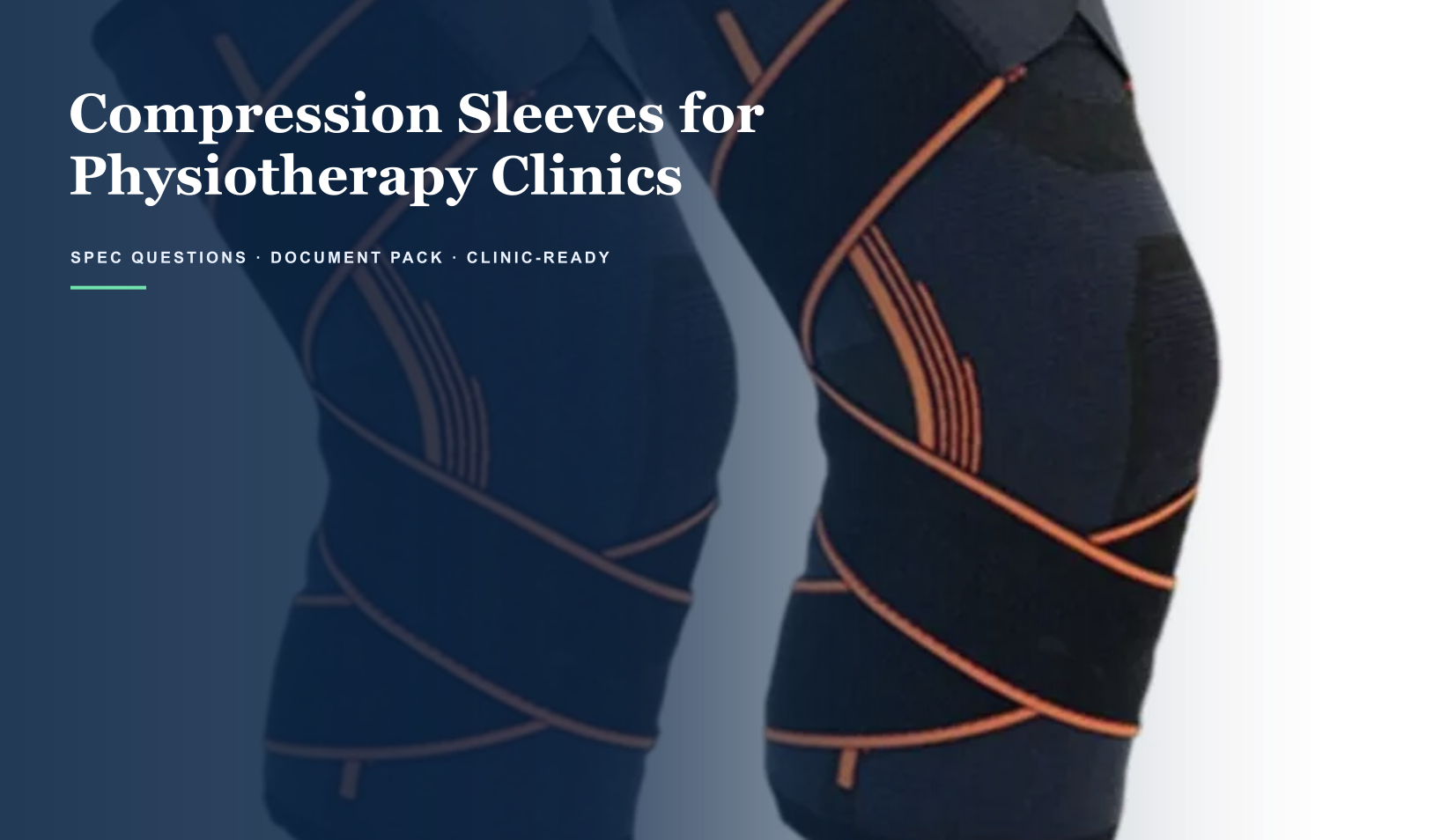
Direct answer. A clinic does not open by asking whether your compression sleeve for physiotherapy clinic range is good. It asks whether you can hand over the specification and the documents behind it. Four things get tested: the written basis for sizing and fit, the label and care information, packaging and lot-level traceability for repeat orders, and the boundary of what you can and cannot say. This page turns clinic questions into a line-by-line list, and sets out the pack to prepare before the first request arrives. It is a B2B sourcing and documentation-preparation guide, not medical, legal, or compliance advice, and the classification and threshold questions are handed off in Section 4.
1. Who is actually asking
Three different people raise three different kinds of question when a clinic channel opens. Most of the friction in this channel comes from answering one kind with the material meant for another — usually by replying to a clinical question with a marketing sentence, or to a documentation request with a verbal reassurance.
What the distributor is really being asked
For you, the question is supply and evidence: can you keep the item available in the sizes the clinic orders, and can you produce the paperwork its buying side asks for. A distributor who can answer both in writing is already ahead of one who cannot, because in our experience clinic conversations often start from doubt about documentation rather than doubt about the item.
What the clinic's buying and operations side is asking
Buying and operations care about the mechanics of a repeat order: which sizes are covered, what arrives in the box, how the size is marked, how a batch is identified, and what happens when a delivery does not match. These questions are answerable with a document. None of them require you to say anything about a body.
What a clinical lead is asking
A clinical lead's question is narrower than it sounds. They want to know whether the item is workable inside the way their team hands items out, sizes them and records them. When the conversation moves to whether an item suits a particular person or clinical situation, it stops being a distributor question: route it to the clinic and its own clinical team, and keep your own material to specification and documentation.
The one-line boundary
This page covers specification and documentation. Clinical judgment is not a distributor deliverable, and it is not written into this page. How knitted ranges are designed across different markets and channels as a whole is set out in how a knitted range is designed for different markets; what follows stays on the clinic-facing question set.
2. The spec questions clinics ask
The specs a compression sleeve for physiotherapy clinic use comes down to
In practice, clinics tend to raise four groups of questions: fit and sizing, product form, materials and care, and packaging and identification. The table maps what gets asked, why it comes up, what you should be able to hand over, and what stays outside your answer.
Which body measurements and which height range does the chart cover?: Someone has to turn a measurement into a size, repeatably — The manufacturer's written size chart — Anything about what the item does for a body
Where is each measurement point, and how is the measurement taken?: Two people measuring the same way must reach the same size — A written measuring instruction with the measurement points — Any judgment about which size a particular person should take
Is the largest size on the same chart, or does coverage stop early?: Clinics ask before they order, not after — A statement of the full size coverage offered — A commitment to extend the range
How long is the item, and what does it cover?: It has to be described in a catalogue or a requisition form — The length and coverage line from the specification sheet — —
Is it side-specific or interchangeable?: It changes how pairs are ordered and stored — The product-form line from the specification sheet — —
How is it held in place?: The clinic needs the closure described in words — The stated closure or anti-slip band description from the manufacturer — —
What is it made of?: Composition sits on most clinic requisition forms — The manufacturer's written composition and construction statement — A field the manufacturer has not supplied: leave it blank and mark it
How is it washed and dried?: Whoever receives the delivery passes this on — The label and the written care text — Anything beyond the written care information
How is it packed, marked and counted?: Receiving and storage both depend on it — The pack specification and size-marking method — —
How do you keep the same item consistent on a repeat order?: Consistent resupply is the whole point of the channel — The item reference, the size chart version and the batch identification — A consistency guarantee you cannot document
Sizing and fit
The clinic asks which measurements and height ranges are covered, where each measurement point sits, how the measurement is taken and by whom, and whether the largest size is on the same chart as the rest. What you prepare is a deliverable size chart plus a measuring instruction, as provided in writing by the manufacturer.
If no written chart exists, the honest position is that the chart is being confirmed, not a number you supply yourself. How a sizing system is designed, and how a consumer-facing range is selected, are separate subjects; the point here is narrower — a clinic will ask you for a chart, and you need the written version of it.
Product form
Length and coverage, side-specific or interchangeable, the closure or the anti-slip band, and the edge finish. Each is a line on a specification sheet. Provide the manufacturer's written description; where the description does not exist, the line stays open and is marked as such.
Materials and hand feel
Composition and construction belong in the manufacturer's written document. If there is no composition document, a distributor must not complete that field from memory, from a similar item, or from a verbal comment on a call. Write "awaiting confirmation from the manufacturer" and move on. An invented composition travels into clinic paperwork, and it is the distributor's name that sits at the bottom of it.
Care and durability
Wash and dry instructions come from the label and the written care text. Any expected service life is stated by the manufacturer in writing, or it is not stated at all. A wash instruction is not a durability commitment, and it should not be extended into one in a quote or a range sheet.
Packaging and identification
Single unit or pairs, how the size is marked, whether there is a bar code, and how the carton is marked. Ask what you already have rather than what could be arranged. A related subject sits elsewhere: packing treated as a discipline of order control, rather than as a list of measurements, is covered in how a knitted support supplier builds buyer confidence.
3. The document questions clinics ask
A specification sheet answers most of the technical questions. Documents are the next layer, and they carry a different problem: the clinic, or its buying side, may ask for something that only the manufacturer can produce. The useful habit in this channel is to know who supplies what before you are asked.
The document list, and who supplies what
Product name and item reference: To identify the item on an order and on a reorder — The manufacturer, in writing — Mark "to be confirmed by the manufacturer"; do not invent a reference
Size chart and measuring instruction: So a size can be chosen the same way twice — The manufacturer, in writing — Request it; state that it is pending
Composition and construction statement: Composition appears on requisition and intake forms — The manufacturer, in writing — Leave the field blank; never fill it from assumption
Label content as it will be printed: It is what the clinic and the user will actually read — The manufacturer (label text) — Request the written label text
Care instruction text: Washing and drying have to be passed on — The manufacturer — Request the written care text
Batch or lot identifier format: To tie a delivery to a production run — The manufacturer — Request the identifier format
Origin marking: A record and labelling point for the clinic — The manufacturer — Do not complete this yourself
Return and replacement process: What happens when a delivery does not match — Your own commercial terms, backed by your manufacturer's terms — State your own process in writing
Independent verification, where a clinic requires it: Verification from outside the supply chain — Optional third-party testing the manufacturer may arrange — Ask for it; do not generate it yourself
Product identity
Name, item or model reference, the batch or lot reference and the origin marking. These identify what is being delivered and support a repeat order. Every one of them is produced by the manufacturer in writing. A distributor who fills them in from assumption creates a document problem that surfaces later, on a delivery that cannot be traced back.
Label and care instructions
What will be printed, and in which language. The clinic's own requirements and the requirements in force at the destination both bear on this, and neither is yours to decide alone: confirm the language requirement with the clinic and with the manufacturer in writing before artwork is fixed.
Quality and consistency
Batch identification, a reorder reference, and the process for a delivery that does not match. Ask for these documents; do not interpret them. How such records are read, what fields make them usable and how sampling and acceptance rules work belong to a separate subject: how buyers read a supplier's knitted compression inspection record.
When a clinic asks you to demonstrate something
The first step is not to generate a document. It is to request it from the manufacturer, in writing, and to say plainly that it has been requested. Where a clinic wants verification from outside the supply chain, third-party testing is an optional service a manufacturer may arrange; Aby-Tex's site describes third-party inspection and testing as optional and names SGS and Intertek as examples. That is a description of a service the manufacturer may use — it is not a certification, and it is not a result that exists for any batch.
If the specification itself has to be written from the ground up with a supplier before any of this can be answered, that is a different task, covered in selecting a custom compression sock manufacturer.
4. The regulation line: one sentence and a hand-off
One sentence, and where the depth lives
Whether an item falls into a medical-device category, which pressure thresholds apply to it, whether it sits on the prescription or the non-prescription side, and where clinical use begins are industry-general questions rather than answers this page can give — that is general industry information and not medical or legal advice, and any conclusion has to be verified by the buyer and the buyer's own clinical and regulatory advisers, with the depth on classification, thresholds and documentation set out in the compliance document guide for importers.
That is the whole of it. This page states no threshold, no category name and no regulatory interpretation.
What the distributor does instead
Route the question. Pass a classification, threshold or prescription-status question to the clinic's own clinical and regulatory advisers and to your manufacturer, in writing, and keep any conclusion out of material you produce. Do not place a category, a threshold or a prescription status in a catalogue, a range sheet, a leaflet or a page of your own making — not because the question is unimportant, but because it is not yours to answer, and a wrong answer travels further than a withheld one.
5. Language that keeps you out of trouble
This section is the part that most distributor material gets wrong, and it is the cheapest one to fix. Clinic-facing material fails in three recognisable ways. The list below describes the categories rather than printing the offending phrases, because the phrases themselves do not belong in a compliant page either.
The three categories to keep out of clinic-facing material
Anything that states or implies a result on a body — any wording about a condition changing, any wording about a symptom, and any wording about something inside the body changing for the better or happening sooner than it otherwise would. Softer phrasing that stops short of a direct claim is still in this category; a sentence does not become safe by being gentle.
Anything that puts a professional or institutional authority behind the item — wording that implies a clinician recommends it, that a named clinic or health system uses it, or that a professional body has endorsed it. Aby-Tex publishes no such endorsement, and neither do most manufacturers; if you write one, you own it.
Anything that presents an unverified status as fact — a certification, a registration, a test outcome or a quality label presented as something you or your manufacturer holds, unless the document is in your hands from the manufacturer. Where a document does exist, quote it; where it does not, say so.
The one-question test
Read every sentence you plan to publish and ask which question it answers. If it answers what the item is, what size it is, how it is worn and removed, how it is cared for, how it is packed and how it is reordered, it belongs. If it answers what the item does to a body, rewrite it or delete it. This one test removes almost all of the risk, and it works on social posts and email footers as well as on a product page.
Safe ways to say the same thing
What the item is meant for: "A knitted sleeve in the sizes on the chart, worn at the stated position, held by the stated closure." — It describes construction and fit, which you can document
That you can back up a request: "The specification sheet, size chart and label text are available from the manufacturer on request." — It points to a document instead of a benefit
How it should be worn and removed: "Wearing and removal instructions as printed on the label." — The source is the label, not your judgement
How it is cared for: "The care text and wash symbols as supplied on the label." — Same source, same limit
Why it suits a clinic channel: "Produced across a documented size range and able to be packed for clinic-facing distribution." — It is a statement about supply and packaging
Claims and the evidence behind them
If your channel genuinely needs a verifiable functional claim, the evidence path is a documentation question rather than a copywriting question: the claim text, the test behind it and the document that carries it are all handled as compliance documents. That depth sits with the compliance document guide for importers. This page does not decide whether any claim is supportable, and no manufacturer's claim should be treated as settled because a distributor repeated it.
Who signs off
Clinic-facing material should be confirmed by the clinic and its own clinical and regulatory advisers, together with your manufacturer, before it goes out. A distributor is not the party that issues a compliance or clinical conclusion, and should not write one on the manufacturer's behalf.
6. Build the clinic-facing pack before the first clinic asks
What the pack contains
A distributor who already has the pack built answers a first clinic enquiry faster than one who starts from scratch. It has six parts, and two of them are yours rather than the manufacturer's.
Product specification sheet: What the item is, its dimensions, coverage, closure and size range — Manufacturer's written version; unsupplied lines marked pending
Size chart and measuring instruction: Measurement points and how each measurement is taken — Manufacturer's written version; no self-completed chart
Label and care text sample: The exact text that will be printed, and in which language — Manufacturer's written version
Packing and carton instructions: Unit pack, size marking, bar code and carton marks — Manufacturer's written version
Batch and replenishment information format: How a batch is identified, and how a reorder is placed — Manufacturer's written version
Your internal wording boundary list: The phrasings your team must not use in clinic-facing material, built from the categories in Section 5 — Yours to maintain and to re-brief on
Marking the gaps
Any field the manufacturer has not supplied stays blank and is marked "awaiting confirmation from the manufacturer". Do not substitute a typical value, a range from a similar item, or a number that sounds plausible. A pack with three honest gaps is usable in front of a clinic; a pack with one invented figure is not, because the invented figure is the one that gets quoted back to you.
How one round of questions is handled
Sort every incoming question into three buckets: specification, documentation, and clinical. Specification and documentation questions go into the pack and come back with a written answer. Clinical questions are routed to the clinic and its clinical team, every time, with the same wording — this is a process, not a judgement call, and having it decided in advance is what stops an improvised answer leaving your desk.
Sampling and confirmation
Where the clinic channel needs an adapted sample, the target custom sampling window is 7 days. Confirm the sample reference and the size chart version in writing before the sample goes out, so that the item the clinic sees and the item on the specification sheet are the same item.
Two adjacent subjects sit elsewhere, and neither is needed to answer a clinic question. If your route to clinics also runs alongside consumer marketplaces, the listing and replenishment side is handled in launching a private-label compression sock brand on Amazon. Volume, trial-order design and lead-time planning are a separate exercise, covered in planning lead times and trial orders. What a manufacturer can customise in a knitted construction is background to the pack, and is described with Aby-Tex's published development process in flexible OEM capabilities. Aby-Tex is a knitted support and compression manufacturer working in OEM, ODM and private-label programmes.
7. Quick answers (assumption-based FAQ)
What specification questions does a clinic usually ask?
Four groups: fit and sizing (which measurements and height ranges the chart covers, where the measurement points are, whether the largest size is included), product form (length and coverage, side-specific or interchangeable, the closure, the edge finish), materials and care (composition, construction, wash and dry instructions), and packaging and identification (single or paired, size marking, bar code, carton marks). For each one, your answer is the manufacturer's written version, or a clear statement that it is being confirmed. Confirm against the manufacturer's written materials, the clinic's own requirements and the rules in force at your destination, and have the clinic's clinical and regulatory advisers verify.
What documents will a clinic or its buying side ask for?
Typically the product name and item reference, the size chart and measuring instruction, the composition and construction statement, the label content as it will be printed, the care text, the batch or lot identifier format, the origin marking, and the return and replacement process. Where the clinic wants verification from outside the supply chain, third-party testing is an optional service a manufacturer may arrange — a service description, not a certification and not a result for any batch. Confirm against the manufacturer's written materials, the clinic's own requirements and the rules in force at your destination, and have the clinic's clinical and regulatory advisers verify.
What do I say if a clinic asks how an item is classified, or what pressure threshold applies?
You hand it over rather than answer it. Pass the question to the clinic's own clinical and regulatory advisers and to your manufacturer in writing, and keep any conclusion out of material you produce yourself. Section 4 holds the one industry-general sentence this page states on the subject, together with the link to the compliance document guide that carries the depth. Confirm against the manufacturer's written materials, the clinic's own requirements and the rules in force at your destination, and have the clinic's clinical and regulatory advisers verify.
Which wording must never appear in clinic-facing material?
Three categories, described in Section 5: anything that states or implies a result on a body, anything that puts a professional or institutional authority behind the item, and anything that presents an unverified status as fact. The practical test is a single question — does the sentence answer what the item is, how it is sized, worn, cared for, packed and reordered, or does it answer what the item does to a body. Confirm against the manufacturer's written materials, the clinic's own requirements and the rules in force at your destination, and have the clinic's clinical and regulatory advisers verify.
What if the manufacturer cannot produce a document yet?
Mark the field "awaiting confirmation from the manufacturer", record the date you asked, and say the same thing to the clinic. What breaks a clinic relationship is not a gap; it is a gap that was quietly filled with an assumption that later contradicts the delivery. Confirm against the manufacturer's written materials, the clinic's own requirements and the rules in force at your destination, and have the clinic's clinical and regulatory advisers verify.
How long does a clinic-channel sample take?
Aby-Tex states a 7-day target for custom sampling on its site. Treat that as a planning target for an adapted sample, and confirm the sample reference and the size chart version in writing before it ships. Confirm against the manufacturer's written materials, the clinic's own requirements and the rules in force at your destination, and have the clinic's clinical and regulatory advisers verify.
8. Next step
Build the pack before the first clinic asks, then send the list with your request. Bring the clinic-facing list you have already assembled — the item types, the size coverage you need, the packaging form, the clinic channel you are supplying, and the questions you have already been asked — and ask the manufacturer for the product specification sheet, the size chart and measuring instruction, the label and care text sample, the packing and carton instructions, the batch and replenishment information format, and an adapted sample for the clinic channel under the 7-day target sampling window.
Use the contact page (/contact-us) or email sales@aby-tex.com. Aby-Tex states a target of a reply within 24 business hours.