Product Knowledge
Arch Support Socks vs. Graduated Compression Socks: What Private Label Buyers Should Know
Arch support socks or graduated compression socks? Compare knitting, fit, pressure testing and OEM requirements before developing your private-label range.
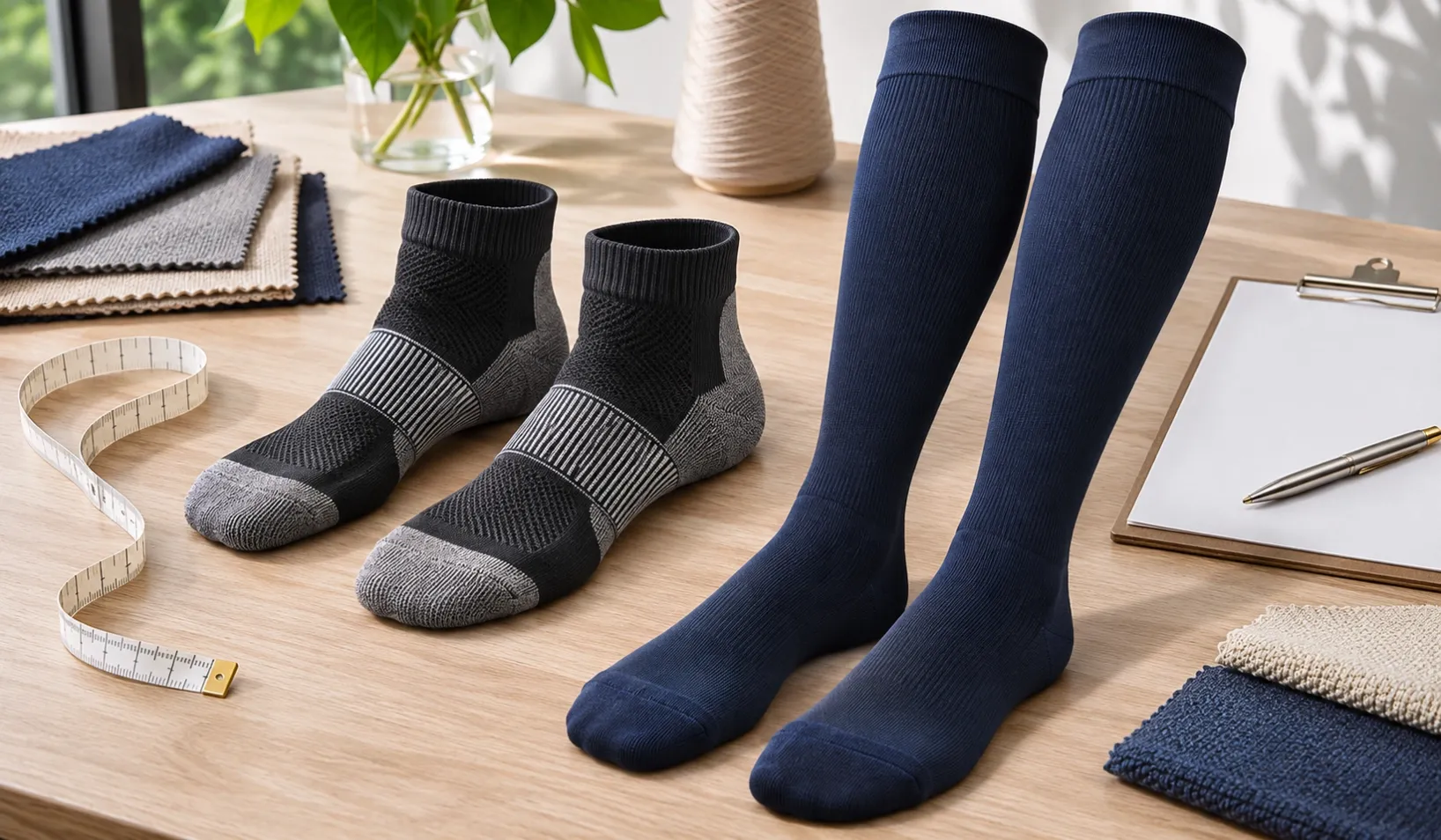
Two pairs of socks can look remarkably similar in a product catalog.
Both may have elastic knitting, reinforced heels and a snug fit. Both may be marketed as support socks. Yet one is designed with a tighter knitted band around the arch, while the other is engineered to deliver a specified pressure gradient along the leg.
For brands and importers developing a private-label sock collection, this distinction matters.
It affects the knitting construction, size specifications, testing requirements and, ultimately, how the product should be presented to customers.
What Makes an Arch Support Sock Different?
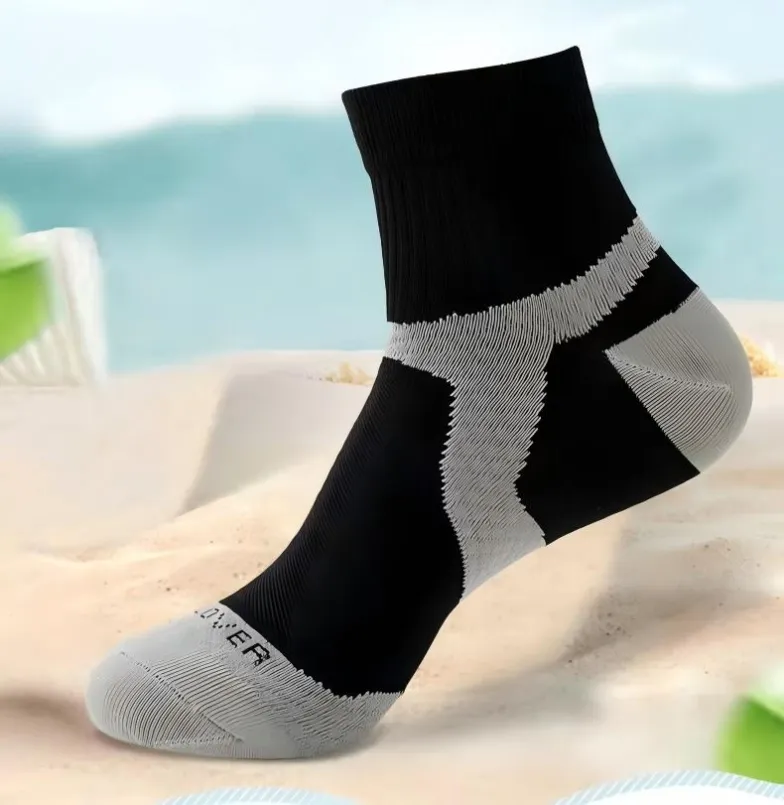
An arch support sock typically features a tighter knitted section around the midfoot.
This section is often created by adjusting the knitting structure and elastic yarn tension to form a band that fits closely around the arch area.
The design is common in athletic and performance-oriented socks, where brands may want a more secure fit around the foot.
Depending on the construction, an arch band can help hold the sock closer to the midfoot. It may also provide a noticeable feeling of local compression.
However, the presence of this band does not establish that the sock provides clinical arch support, corrects foot alignment or treats conditions such as plantar fasciitis.
Those are separate performance claims requiring appropriate evidence.
For private-label buyers, the more useful questions are practical ones.
How tight should the arch band feel? Will the sock remain comfortable inside athletic footwear? Does the elastic structure recover after repeated wearing and washing?
These details are worth discussing before requesting samples.
How Graduated Compression Socks Work
Graduated compression socks are built around a different principle.
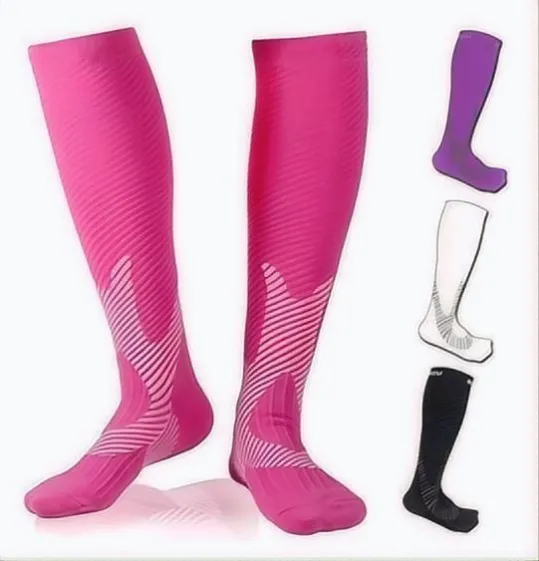
Their defining feature is a controlled pressure profile, with the highest specified compression generally applied at the ankle and progressively lower pressure farther up the leg.
Unlike a standard arch support band, graduated compression is not simply a matter of making one knitted section tighter.
The finished product must be developed around defined pressure requirements.
For example, a buyer may request a knee-high compression sock with a specified ankle pressure range of 15–20 mmHg.
That number refers to a pressure specification, not the percentage of elastic yarn or how tightly the sock feels when stretched by hand.
Yarn selection, knitting construction, finished dimensions and leg circumference can all influence the pressure delivered by a sock.
This is why pressure testing matters.
If a brand intends to advertise a specific mmHg range, the supplier should be able to explain the testing method, measurement conditions and how the stated pressure is verified across relevant sizes.
A visually convincing sample is not enough to confirm graduated compression performance.
A Side-by-Side Comparison for Buyers
Feature | Arch Support Socks | Graduated Compression Socks |
|---|---|---|
Main design focus | Localized fit around the midfoot | Defined pressure profile along the leg |
Knitting construction | Elastic arch band and selected fit zones | Engineered knitting and tension distribution |
Typical positioning | Athletic and everyday performance socks | Travel, everyday compression, wellness or medical applications, depending on specifications |
Sizing considerations | Foot length, midfoot fit and sock construction | Foot size, ankle and calf circumferences, leg length |
Performance verification | Fit, stretch recovery, wear and wash testing | Fit and durability, plus appropriate pressure testing |
mmHg rating | Not established by an ordinary arch band | May be specified and verified for the finished product |
Neither product is automatically better.
They serve different design purposes, and either may be suitable for a particular brand's collection.
It is also possible to incorporate a supportive arch band into a graduated compression sock.
In that case, however, the complete construction still needs to meet the required pressure specifications.
The Detail Buyers Often Overlook: Sizing
For arch support socks, development often begins with foot size.
But shoe size alone does not fully describe the shape of a foot.
Two wearers with the same shoe size may have different midfoot circumferences or instep heights.
If an arch band is too restrictive, it may create an uncomfortable localized pressure point. If it is too loose, it may not deliver the intended close-fitting feel.
Brands should therefore evaluate the arch band's position, stretch and recovery across the planned size range.
Graduated compression socks require additional measurements.
Ankle circumference, calf circumference and lower-leg length become especially important for knee-high styles.
A sock may fit the foot correctly but still fall outside its intended pressure specification on a differently shaped leg.
This creates a particular challenge for private-label brands selling online, where customers select sizes without trying on the product.
A clear size guide is part of the product development process, not merely a packaging detail.
What Should You Ask Your Supplier to Test?
Suppose you are developing two products for the same sports accessories collection: an ankle-length arch support sock and a knee-high graduated compression sock.
You would not approve both samples using exactly the same criteria.
For the arch support sock, your evaluation might focus on whether the midfoot band sits in the intended position, whether the sock feels comfortable inside footwear and whether the knitted structure retains its fit after repeated stretching and laundering.
For the graduated compression sock, those general quality checks remain relevant.
But you also need to verify that the finished product meets its specified pressure requirements.
The testing method, acceptance criteria and size coverage should be agreed upon before bulk production.
For either product, material substitutions deserve attention.
Changing the elastic yarn or knitting structure may alter how the sock fits, even when the finished product looks almost identical to the approved sample.
That is particularly important when planning repeat orders.
Should Your Brand Offer Both?
That depends on your customers and your existing product range.
A running accessories brand might find an arch-band sock suitable for a collection built around footwear fit, construction details and everyday training accessories.
A distributor developing a graduated compression range may need products with clearly defined pressure specifications, detailed size charts and supporting performance documentation.
There is also room for both categories within a wider sock collection.
The important thing is to give each product a clear purpose.
If two products have similar packaging, similar descriptions and no obvious difference in use or construction, customers may struggle to understand why they should choose one over the other.
From a purchasing perspective, unnecessary product overlap also increases the number of SKUs that need to be stocked and replenished.
Before adding another style, make sure it offers a meaningful difference.
Developing a Private-Label Sock Collection
For OEM development, an accurate product brief is more useful than a long list of requested features.
If you want arch support socks, explain where the knitted band should be positioned, what type of footwear the product is intended for and which aspects of fit matter most.
A reference sample can be particularly helpful.
For graduated compression socks, specify the intended length, size range, target pressure profile and relevant testing requirements.
In both cases, discuss yarn options, colors, packaging and order quantities once the main product construction is clear.
It is also worth asking whether the proposed materials can be sourced consistently for repeat orders.
A slightly lower quotation offers little advantage if a change in yarn or knitting construction makes the next production run noticeably different.
Choosing the Right Product for Your Market
Arch support socks and graduated compression socks should not be treated as interchangeable products.
One focuses primarily on a localized knitted structure around the foot. The other is defined by an engineered pressure profile that requires suitable verification.
Understanding that difference helps buyers develop clearer specifications, compare supplier quotations more accurately and avoid unsupported product claims.
For private-label brands, a successful product starts with knowing exactly what it is designed to do.
Explore Custom Sock Development With Aby-Tex
Aby-Tex works with brands, importers and wholesalers on OEM and private-label knitted products.
For sock development projects, we can discuss yarn options, knitting construction, sizing, sample evaluation and packaging requirements.
If you are considering a new arch-band sock design or expanding your compression sock range, contact Aby-Tex with your product concept, reference samples and estimated order quantity.
We can review the requirements and discuss suitable development options.