Oct 26, 2026Manufacturing & Capabilities
How to Launch a Private-Label Compression Sock Brand on Amazon: A Manufacturer's Checklist
Packaging, barcodes, compliance documents and reorder timing decide whether a private-label compression sock launch stalls. Here is the checklist to hand your manufacturer.

Direct answer (the short version). Launching a private-label compression sock on Amazon comes down to four jobs: (1) decide what you are actually ordering — a catalog sock with your label, or a sock built to your own construction (the selection method is here); (2) turn that idea into a one-page spec a factory can quote; (3) get packaging and barcodes right for the marketplace; and (4) assemble the documents your listing may be asked to show and set a reorder cadence. This article is about jobs three and four — the launch-execution half. Jobs one and two belong to the sourcing guide linked above.
1. What "private label on Amazon" means for a sock (and where it stops)
You do not need the full private-label/OEM/ODM taxonomy in a launch article — that decision, and the technical spec behind it, is the sourcing guide's job. What matters on Amazon is narrower: tell the factory which parts of the product are fixed and which parts are yours. A "private label" order usually means you take a product the factory already makes and put your brand on it. A "rebuild" order means you define construction, features or sizing yourself. Everything below — packaging, barcodes, documents — changes depending on which one you chose, and neither path is wrong; being vague about it is what causes delays.
Label or rebuild? What one order asks the factory for
For a launch you will be quoted on a short list of line items. Have an answer for each before you send an inquiry:
Product family — for example a zippered compression sock, a non-zippered sock, or an anti-slip sock.
Compression class / pressure zone — define it with the factory; the sourcing guide covers how, so do not guess here.
Size run and fit notes — which sizes you will actually stock at launch.
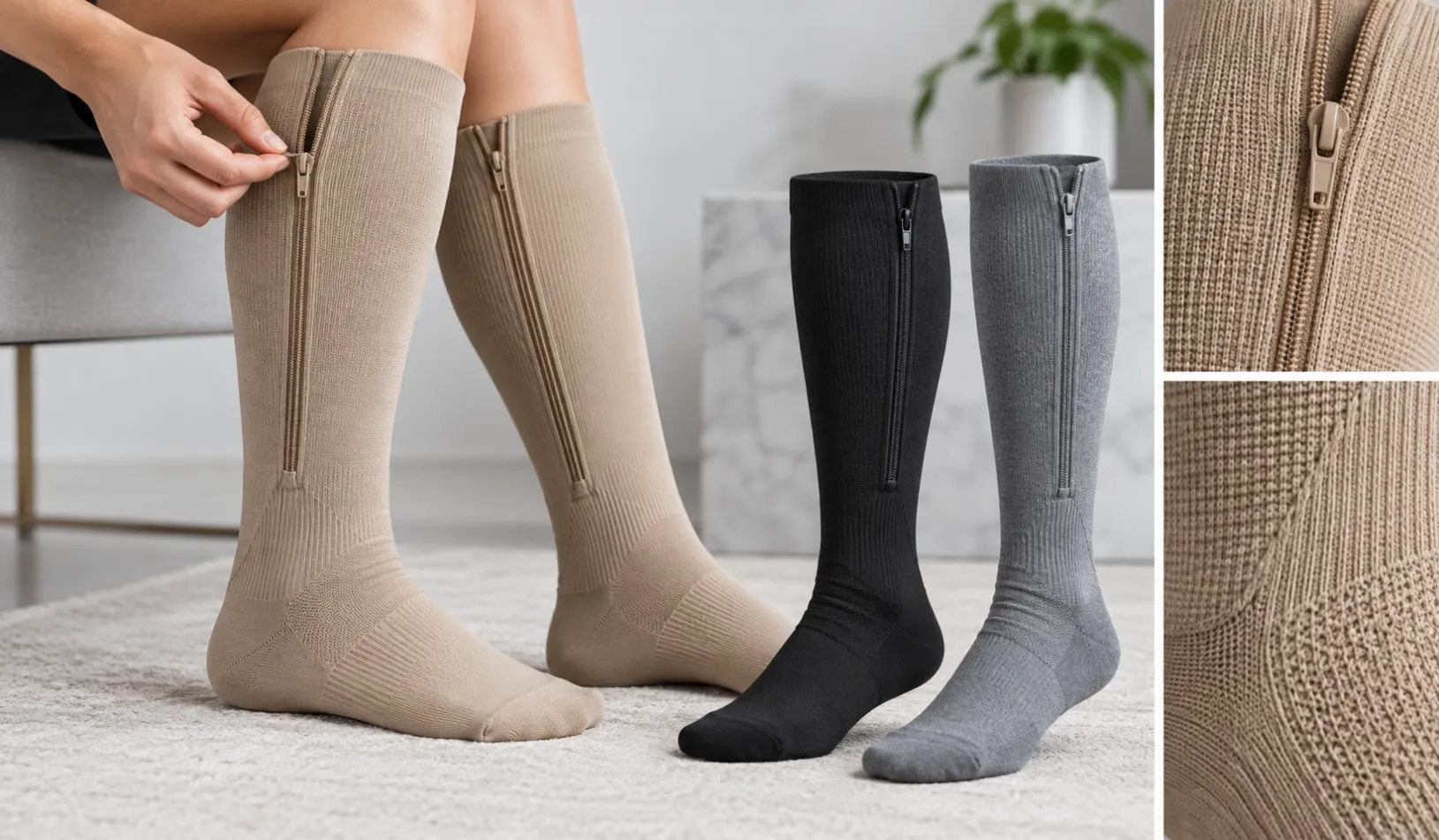
Color, yarn feel and features — zipper, anti-slip band, toe style, cushioning.
Your brand mark — where the logo, label and size tag go.
Packaging format and artwork — retail-ready or polybag (see Section 2).
Barcode / GTIN — the data you will supply.
Quantity and target delivery window — first order and a reorder estimate.
Destination market — US / North America, and how it ships.
If your plan needs materials, colors or packaging that flex beyond one catalog item, that capability is worth checking early. A partner that presents flexible OEM capabilities can usually tell you up front what is customizable and what is not.
The one-page spec you should have before launch
You do not need a 30-page tech pack to start — you need one page a factory can quote from. Use the fields below as fields to fill in, not as parameters to teach yourself; the technical depth (compression class, gradient, yarn, knit structure, size grading) is handled in the manufacturer selection guide.
Product reference: Sock type + your internal SKU name — Buyer
Intended use and user: Recovery / travel / standing work / medical-positioned (see Section 3) — Buyer
Compression spec: Class and zone — define with the factory, do not guess — Buyer + factory
Size run: Which sizes you stock at launch — Buyer
Color and features: Zipper, band, toe, cushioning — Buyer
Branding and artwork: Logo files, label, print placement — Buyer
Packaging format: Retail-ready or polybag; carton type — Buyer + factory
Barcode data: GTIN/UPC, or the format you will provide — Buyer
Quantity: First order and reorder estimate — Buyer
Target market and delivery: US / North America, requested window — Buyer
Documents you require: See the request list in Section 3 — Buyer
2. Packaging and barcodes: the marketplace-specific build
This is where an Amazon launch differs most from a normal wholesale order. The factory builds the sock; you (or your prep partner) decide whether the unit can go straight into a fulfillment center. Two of the most common launch delays are a barcode that does not match the listing, and packaging that does not survive fulfillment-center handling.
Retail-ready packaging vs polybag
The first call is channel format. A retail-ready unit (printed card or box) tends to carry your brand better and protects the product in transit, but it costs more, weighs more, and can complicate barcode placement. A plain polybag is cheaper and lighter, but you still have to meet labeling rules and keep the unit scannable. Neither is automatically "correct" — choose the one that fits how the product will be stored, picked and shipped, then lock the artwork early.
This is also where market and channel matter: a unit built for one sales channel is not automatically ready for another, and small differences in labeling, packing density and carton configuration add up. For how requirements shift across markets, see compression solutions for different markets.
UPC/GTIN, FNSKU and barcode placement
General education, not legal advice. Verify all of this against the current Amazon Seller Central policy before printing anything.
Three identifiers get confused at launch:
UPC/GTIN — the brand-side product identifier you use to create the listing. You normally obtain and own this.
FNSKU — the identifier Amazon uses to track your inventory. It is not your UPC, and the two must not be swapped.
Carton and unit barcodes — different labels for different levels; the unit barcode must be scannable on the actual pack.
Typical new-seller errors: printing a barcode too small or low-contrast to scan, applying the FNSKU label in a way that covers the UPC, or assuming the factory will handle labeling that your channel actually expects you or your prep partner to apply. Confirm in Seller Central who applies what, then confirm with the factory who prints what.
Packaging and barcode fields to confirm with your manufacturer
Use this as the field list you send alongside your one-page spec:
Unit packaging type: Retail-ready box/card vs polybag; finished size
Unit barcode: Who supplies the GTIN; who prints it; symbology and data
Barcode placement: On product / on bag / applied label; quiet zone and contrast
FNSKU handling: Applied by you or your prep partner — verify current Amazon policy
Brand / size / care labels: Content and position on the unit
Carton type and count: Units per carton; single-SKU vs mixed cartons
Carton marking: SKU, quantity, weight, dimensions, country of origin
Packing list fields: SKU, quantity, lot, carton ID
Polybag details: Suffocation-warning text, vent holes, bag thickness
Insert / marketing card: Whether it is allowed and how it must be worded
Carton marking, packing lists and mixed cartons
Carton-level details are easy to skip and annoying to fix later. Agree on the carton label content, the packing-list fields, and whether your channel wants single-SKU or mixed cartons. Get a carton-artwork proof approved, and keep a copy — it becomes the reference if a shipment is questioned. Everything here is a field to agree with the factory and your prep partner, not a spec to assume the factory already has.
3. Compliance documents your listing may require
General education, not legal advice. Compression products sit in a regulated space and marketplace policies change. Nothing in this section is legal advice, and nothing here is a statement about Aby-Tex's certifications or registrations. Verify the current FDA rules and the current Amazon Seller Central requirements for your exact product, market and claims before you commit wording to packaging or a listing.
Positioning first: medical vs wellness framing
One sentence, because the depth belongs elsewhere: whether you present the sock for a therapeutic/medical use or for general wellness changes which regulatory pathway and documents apply — in the U.S., compression products at or above roughly 20 mmHg are generally treated as medical devices (some requiring a premarket submission such as a 510(k)), while lower-pressure, wellness-positioned products are often treated differently — so settle the positioning before you write packaging copy, and take the regulatory detail from the manufacturer selection guide. Outside the U.S., the EU's MDR classifies therapeutic compression products under its own scheme; if you sell there, confirm classification with current regulation and a qualified advisor.
Documents to request from your manufacturer
Ask for these in writing, and treat each one as "needs verifying" until you have seen the actual document with a date, a lab or issuer, and an identification of the product it covers:
Material composition statement — fiber content as it will appear on the label.
Care and wash instructions — the exact care-label content.
Country of origin statement — and how it is marked on product and carton.
Product test reports relevant to the claims you plan to make (for example, pressure measurement or fabric performance), naming the testing laboratory.
Third-party inspection or test reports if you commissioned them (providers such as SGS or Intertek are commonly used).
Any conformity or compliance certificate for a standard you or the channel require — ask explicitly; do not assume it exists.
Declaration documents for a medical-device pathway, if that pathway applies.
Packaging artwork proof and label-content approval record.
Batch / lot traceability convention — how a produced lot is identified.
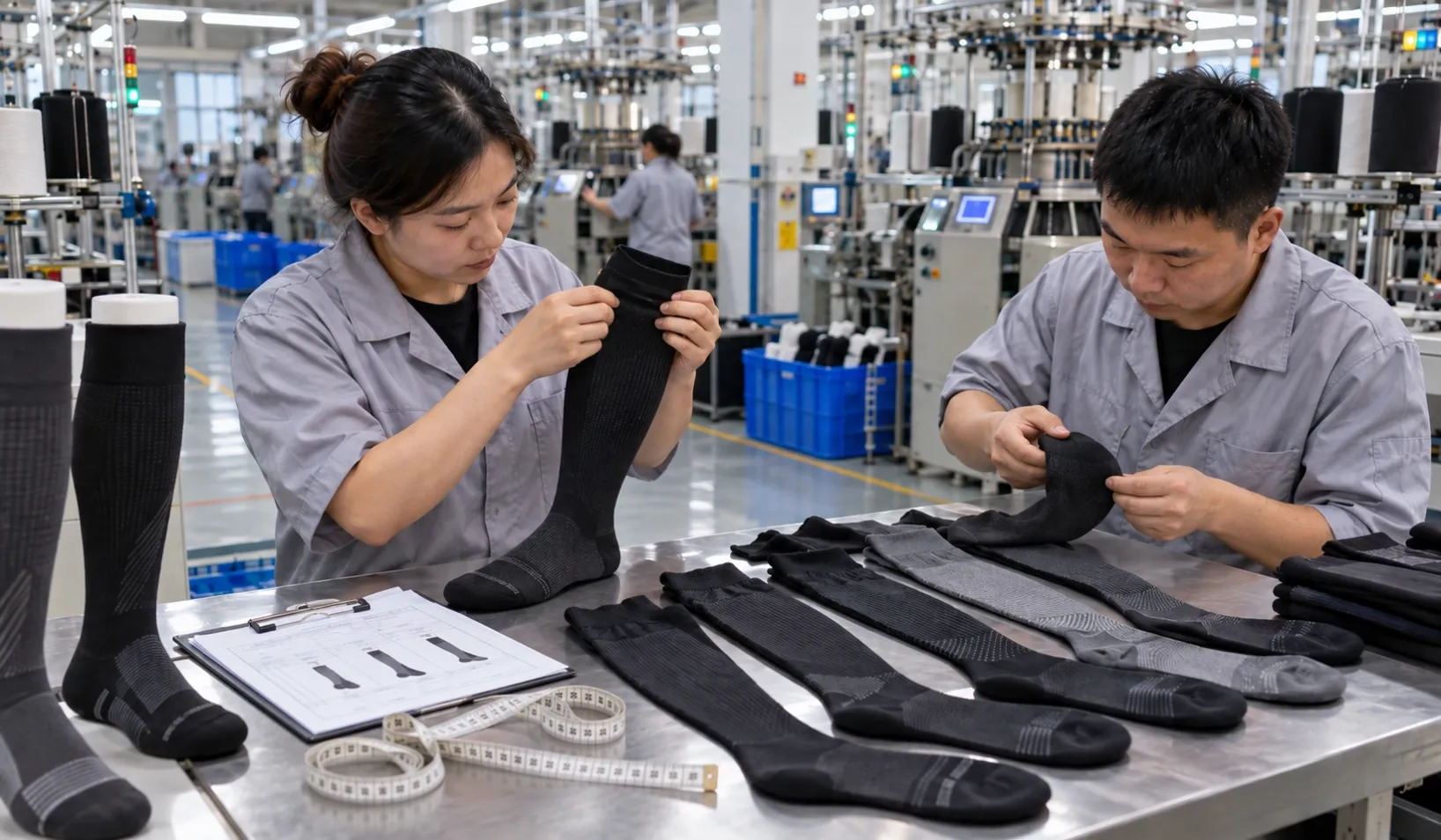
On the Aby-Tex side specifically, the site describes optional third-party inspection and testing (for example via SGS or Intertek) and a quality process that runs from raw-material confirmation through pre-shipment inspection — including a packaging check. That is a description of a process, not a certification claim, and certifications remain something you must ask about and verify for any supplier.
The mistake to avoid: "the factory says it has tests" is not a report
A verbal "yes, we test it" is not a document you can file, and it will not help if your listing or a customer challenges a claim. Watch for reports that are expired, that cover a different construction or size, that name no laboratory, or that use no stated test method. Ask for a dated PDF that identifies the sample and the method. Keep it with the SKU record so the next order and the next listing update start from the same evidence.
4. Replenishment and reorder cadence
First order and reorder lead times are two different numbers
The first order includes development and sampling; a reorder does not. Ask for both numbers separately, in writing:
First order — sampling plus production. For reference, Aby-Tex states a target of 7 days for custom sampling on its site, after which production runs.
Reorder — production only, and usually shorter if yarn and specifications are held consistent.
A supplier who quotes one lead time for both has not thought about your launch. If the yarn or construction changes between orders, expect the "reorder" timeline to reset.
MOQ and trial orders that serve "test, then replenish"
A large minimum order forces you to buy inventory before you know how it sells. A launch-friendly supplier offers a flexible minimum and a trial-order path, so you can validate the listing on a small run and then scale. Aby-Tex cites flexible MOQs and trial-order support; whatever supplier you use, get the minimum and the trial terms in writing rather than assuming them. How a supplier handles the sampling-to-repeat-order relationship is itself a trust signal — see how a knitted support supplier builds buyer confidence.
Buffers and peak-season rhythm
General industry practice, not a promise. Size your buffer to two things you control: your actual sell-through rate and the supplier's repeat-order lead time. If a reorder takes weeks, your buffer has to cover weeks. Peak retail periods compress factory capacity, and Chinese New Year is a well-known production slowdown window — build those into your calendar and confirm the impact with your supplier well before you need it.
5. An Amazon-launch checklist to hand your manufacturer
Print this, fill in the buyer-owned fields, and send it with your one-page spec. It is the whole article in one page.
Spec fields
Product family and internal SKU name
Intended use and user
Compression class / zone (defined with the factory)
Size run for launch
Color and features
Branding and artwork files
Quantity: first order + reorder estimate
Destination market and requested delivery window
Packaging and barcodes
Unit packaging type (retail-ready or polybag) and finished size
GTIN owner, printer, symbology and data
Barcode placement and quiet zone
FNSKU application owner (verify current Amazon policy)
Brand / size / care label content and position
Carton type, units per carton, single-SKU vs mixed
Carton marking content and packing-list fields
Polybag details (warning text, holes, thickness) if used
Insert / marketing card wording, if used
Documents to request
Material composition statement
Care and wash instructions
Country of origin statement and marking
Product test reports tied to your claims, with lab named
Third-party inspection / test reports, if commissioned
Any required conformity certificate (ask explicitly)
Batch / lot traceability convention
Packaging artwork proof and label approval record
Replenishment
First-order lead time (sampling + production)
Reorder lead time
MOQ and trial-order terms in writing
Buffer sized to sell-through and reorder lead time
Peak-season and Chinese New Year calendar impact confirmed
6. Quick answers (FAQ)
Do I need a UPC to sell a private-label compression sock on Amazon?
In most cases a listing needs a valid product identifier (GTIN/UPC), and you normally obtain and own it as the brand. There are exceptions tied to brand and catalog status. Confirm the current requirement in Amazon Seller Central before you buy or print anything.
Can my manufacturer print the barcode and apply the FNSKU?
The GTIN data is yours; who physically prints or applies labels is a commercial decision you must agree explicitly. FNSKU labeling is often handled by the seller or a prep partner rather than the factory — verify this against current Amazon policy and state it clearly in your order so nobody assumes.
How long does a private-label compression sock sample take?
It depends on the construction and the supplier. For reference, Aby-Tex states a target of 7 days for custom sampling on its site, with production lead time quoted separately. Always ask for the sampling and production numbers separately.
7. Next step
Write your one-page spec, attach the packaging and barcode field list above, and send the document request list at the same time — that is the fastest way to get a factory response you can actually use. Send it through the contact page (/contact-us) or email sales@aby-tex.com to request spec feedback and a quote; Aby-Tex targets a reply within 24 business hours.
Explore Custom Compression Sock Solutions
Looking for a reliable supplier for your next compression sock project?
Aby-Tex supports private-label compression socks with customization options for yarns, compression specifications, sizing, colors and packaging.