Oct 28, 2026Product Knowledge
Knitted Knee Sleeves vs. Adjustable Knee Supports: Which Should Your Brand Source?
Compare knitted knee sleeves and adjustable knee supports by fit, construction, cost and OEM options. A practical sourcing guide for sports brands.
A sports brand wants to add knee supports to its product collection.
The sourcing team receives two samples.
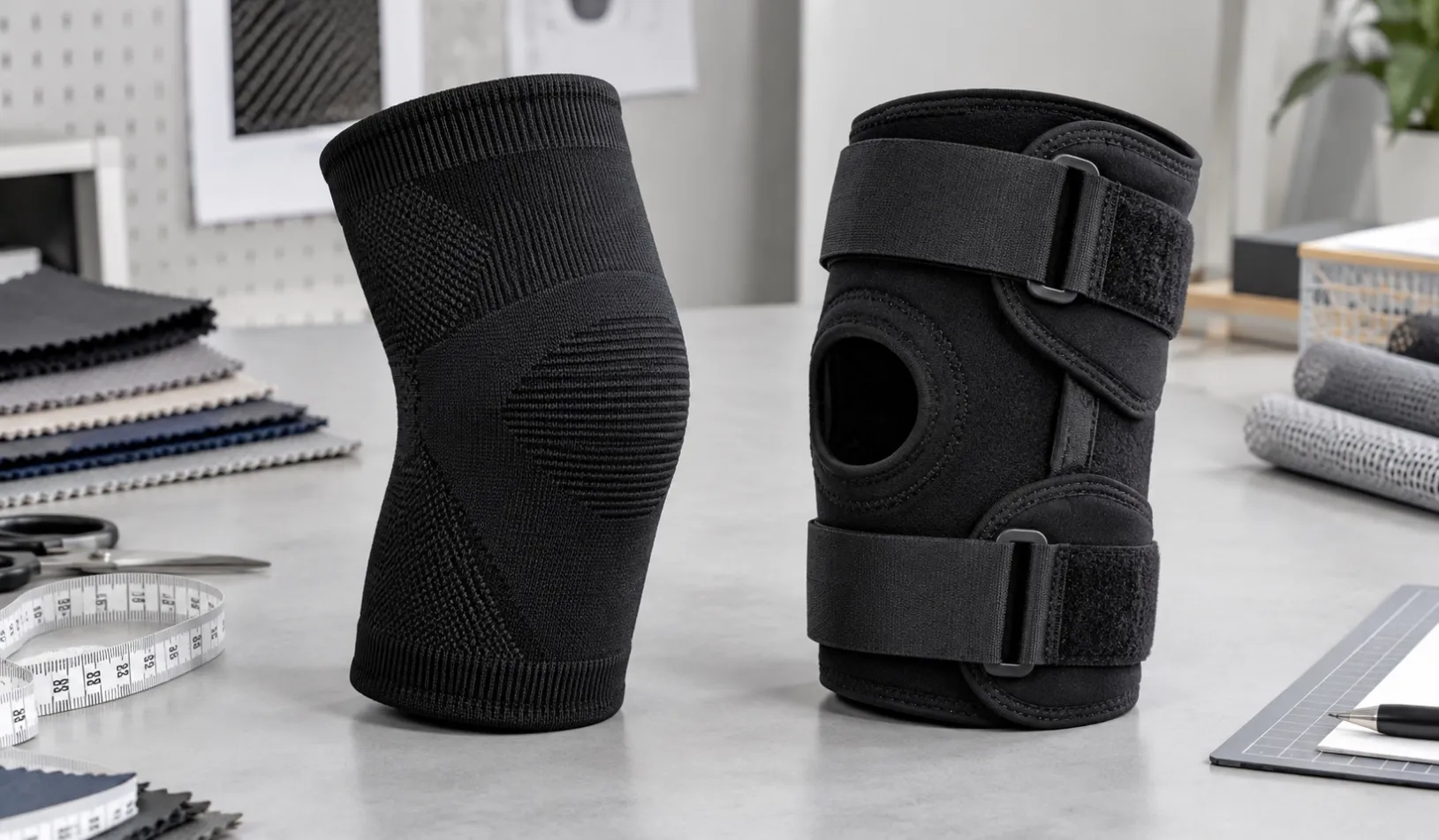
One is a lightweight knitted sleeve that slips over the knee. The other uses a similar knitted body but adds adjustable straps around the leg.
Both look suitable for retail. Both can carry the brand's logo.
But they are not the same product from a development, production or customer-fit perspective.
Which one should the brand choose?
The answer starts with understanding what the buyer is actually trying to offer.
The Basic Knitted Knee Sleeve
A conventional knitted knee sleeve uses elastic yarns and a close-fitting construction.
Its fit depends primarily on the knitted structure, material elasticity and size selection.
This makes the basic sleeve an option worth considering for brands that want a streamlined design with relatively few components.
A buyer evaluating this product should pay attention to three details.
Fit: The sleeve needs to match the intended knee and leg measurements.
Elastic recovery: The material should maintain acceptable fit after repeated stretching and washing.
Position retention: Cuff construction and knitted tension should be reviewed to assess unwanted movement during typical activities.
A simple appearance does not remove the need for careful development.
An incorrectly sized sleeve can still roll, bunch or feel uncomfortable during movement.
What Changes When Adjustable Straps Are Added?
An adjustable knee support introduces another element into the design.
The knitted sleeve continues to provide the main textile construction, while straps create an additional way to adjust the fit.
For buyers, this introduces both opportunities and additional questions.
An adjustable design may accommodate different wearing preferences within its intended size range.
However, straps can also create problems if their position, length or fastening system is poorly developed.
For example, a strap may feel comfortable while standing but interfere with knee bending.
A fastening edge may rub against the opposite leg.
Or the strap may become loose after repeated use.
These are practical design issues that should be evaluated during sampling.
Comparing the Two Products
Buying Consideration | Basic Knitted Knee Sleeve | Adjustable Knee Support |
|---|---|---|
Main construction | Elastic knitted sleeve | Knitted body with added fastening components |
Fit adjustment | Primarily through sizing and elasticity | Sizing plus adjustable straps |
Components | Generally fewer | Usually more |
Sample evaluation | Knit, fit, recovery and movement | Knit and fit, plus strap placement and fastening |
Manufacturing complexity | Often simpler | Usually involves additional assembly or components |
Retail positioning | Streamlined knitted support | Adjustable-fit product option |
Neither construction should automatically be described as providing stronger medical support.
Any specific stabilization, compression or therapeutic claim should be supported by appropriate product evidence.
Think About Your Customer's Buying Decision
Imagine two different sales channels.
The first is an online sports accessories brand selling a compact range of everyday training products.
Its customers may value a lightweight appearance, simple sizing and easy product comparison.
A basic knitted sleeve could be an appropriate starting point.
The second is a specialty retailer looking for a product with more adjustable design features.
An adjustable knee support may provide a clearer point of difference.
But that difference needs to be visible and understandable.
If the straps do not offer a meaningful fitting benefit for the intended product, adding them may simply increase manufacturing complexity.
The design should solve a customer need, not just make the product look more technical.
How Construction Affects the Quotation
When comparing quotations for these products, make sure suppliers are using equivalent specifications.
A knitted sleeve quotation may be influenced by yarn selection, knitting density, dimensions, finishing and packaging.
An adjustable support may also involve strap materials, fastening components, additional sewing or assembly work, and more inspection points.
Consequently, comparing unit prices without comparing construction details can be misleading.
Buyers should request clarification on:
- Main material composition
- Knitted structure and finished dimensions
- Strap material, width and length
- Fastening system and attachment method
- Available size ranges
- Branding and packaging specifications
- Sample approval and quality requirements
A lower quotation is only meaningful when the quoted product meets the intended specification.
What Should Be Tested Before Production?
The sample evaluation should reflect the design.
For a basic knitted knee sleeve, focus on fit across sizes, fabric recovery, edge comfort and position during movement.
For adjustable knee supports, include those checks and add repeated fastening, strap placement and tension distribution.
Test the products during movements relevant to their intended use.
If the buyer plans to market the support for gym activities, for example, the evaluation may include walking, bending and representative training movements.
Record any issues against the approved specification.
The purpose is not to prove that one category is better than the other.
It is to determine whether each product performs as intended.
Could Your Brand Offer Both?
Yes, provided the products serve clearly differentiated purposes.
A brand could use a basic knitted sleeve as its core option and develop an adjustable model for customers who value fastening flexibility.
But offering both only makes sense if customers can understand the difference.
Product names, images, size charts and packaging should clearly explain what distinguishes each model.
Otherwise, the second SKU may create inventory complexity without offering additional customer value.
Final Thoughts
Knitted knee sleeves and adjustable knee supports are different development choices.
The basic sleeve emphasizes a streamlined knitted construction. The adjustable model introduces additional fastening components and fit considerations.
For brands and importers, the right decision depends on the intended customer, target price, design requirements and manufacturing feasibility.
The best product is not necessarily the one with the most features.
It is the one whose features match a real customer need.
Explore OEM Knee Support Development With Aby-Tex
Aby-Tex offers OEM and private-label development options for knitted knee supports.
For sizing, materials, strap customization and sample development, contact Aby-Tex with your product requirements.