Warehouse and Logistics Workers: How to Choose a Back Support for Long Shifts
Choosing a back support for warehouse shifts? Fit, comfort, adjustability and durability to check — and the questions to ask an OEM supplier.
Warehouse and Logistics Workers: How to Choose a Back Support for Long Shifts
For a buyer sourcing back supports for warehouse and logistics teams, the decision is a product-line decision, not a personal fitting decision. The questions are commercial: which constructions belong in the range, which size curve covers a whole team without overstocking slow sizes, and what can be written into a purchase order and checked on arrival.
This guide is written for private-label buyers, distributors and workwear retailers. It is not medical advice or a safety assessment: a diagnosed back condition needs professional guidance.
1. Start with the channel and the end user
Warehouse work is not one activity, and the channel decides which specification matters. Picking, loading, forklift driving and packing may all fall in the same shift, and the support that sells through a team supplier is not necessarily the one that sells through a workwear retailer.
- Team and contract supply: bulk orders, a defined size curve, often a company colour or logo. Repeatability matters more than novelty — the second order must match the first.
- Workwear retail and e-commerce: the listing needs construction, size guide, composition and care instructions. Returns are driven by fit, so the size chart and the description have to agree with what arrives.
- Distributors serving several customers: the same base product may need different packaging, labelling and colourways. Ask early whether the supplier can separate production by customer without mixing specifications.
Buying one model for everyone is how supports end up unused in lockers — and how a distributor ends up with returns.
2. Claims: what a back support can — and cannot — say
Get this right before any product decision, because it affects the labelling as well as the buying.
A back support is a wearing aid: it can give a feeling of support and steady pressure around the waist. It is not personal protective equipment, and it should not be presented as a way to prevent lifting injuries or as a replacement for proper lifting training and mechanical handling aids. In the United States, OSHA does not endorse back belts as a proven means of preventing occupational back injury, and NIOSH has found insufficient evidence to recommend them for that purpose.
That boundary belongs in the listing and packaging: no medical or injury-prevention claim without a proper basis. For a fuller sourcing view, see Back Support Belts for Workwear Distributors: An OEM Sourcing Checklist.
3. Support types: decide the range before the first sample
Warehouse supports generally fall into three constructions. The choice is a range decision: which to carry, and which to leave out.
- Knitted elastic brace: a close-fitting support, often with a reinforced lumbar panel. The commercial case is a low profile under a uniform. Check that the knit recovers its shape and the edges do not roll.
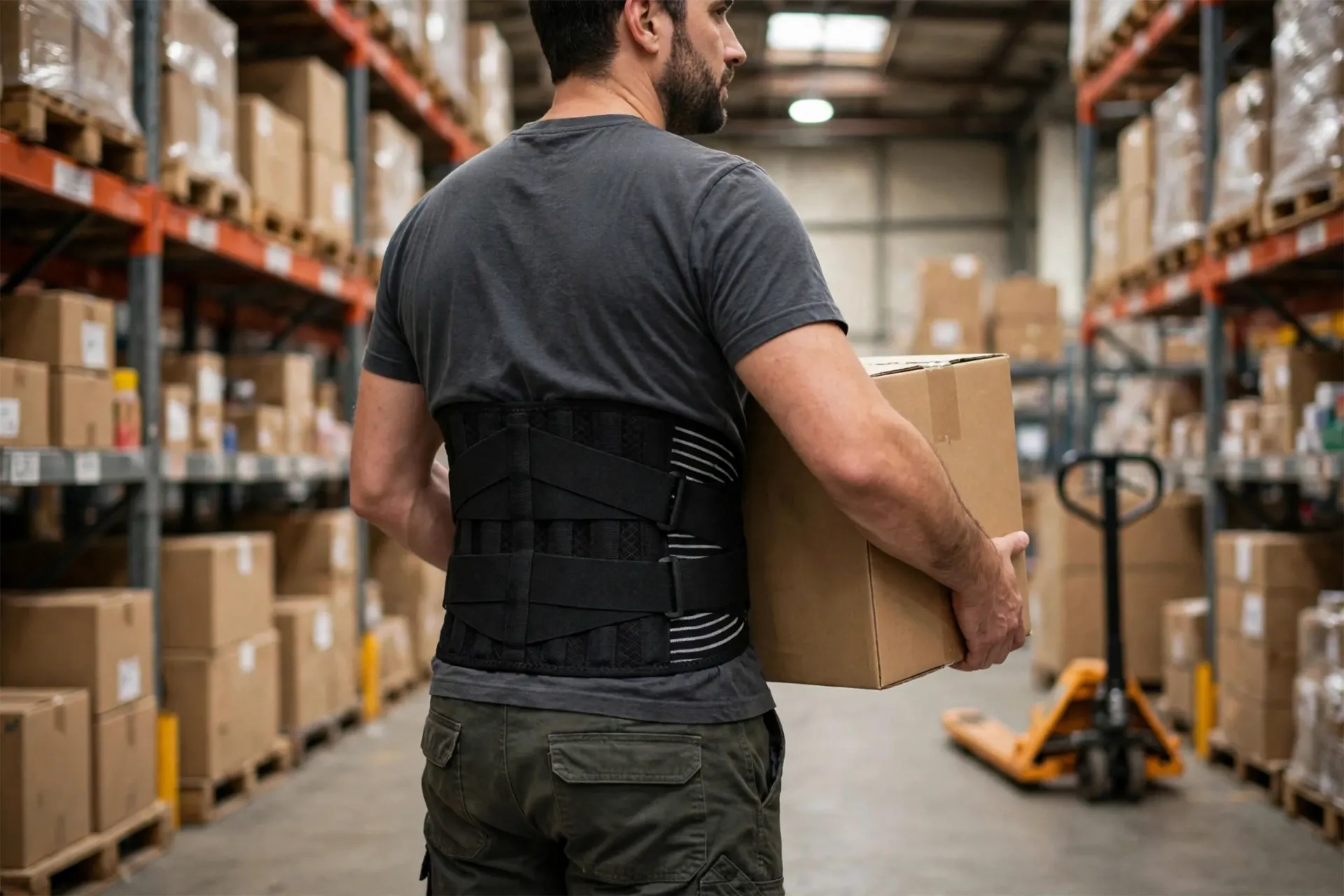
- Adjustable belt with straps: a wider belt that can be tightened or loosened during the shift. The commercial case is one product covering lifting and seated work, which can reduce the number of SKUs to carry. Check the fastening, adjustment with gloves on, and whether the straps stay put once set.
- Brace with flexible stays: a support with flexible reinforcement around the lower back. The commercial case is a firmer feeling of structure. Check that the stays do not dig in when seated or bending, and stay in their pockets after washing.
4. Sizing: plan the size curve, not a single size
A wrong size is a returns problem, not only a comfort problem: too loose and it slides; too tight and it restricts breathing and movement.
Check that the size chart is based on body measurements, not only S/M/L labels: waist circumference where the support will sit, whether it is measured over the uniform, and the fastening's adjustment range.
For a team order, ask how many sizes the supplier offers, whether the range covers the whole team, and whether the same size chart will be kept on reorder.
5. Comfort and durability: the checks that belong in QC
A support is only useful if it stays on for the whole shift, so the comfort checks belong in the order's QC criteria: breathability, checked by wearing the sample through a full shift in the actual warehouse; flat seams and smooth inner surfaces; staying in place during repeated bending, not just while standing; and a fastening adjustable with gloves on.
Wash the sample several times before deciding: a support that loses its hold after a few washes will generate returns across the whole team.
6. What to ask an OEM supplier before the first order
A short checklist. It does not state Aby-Tex's MOQ, price or lead time — confirm those for the specific order.
- What sizes and adjustment ranges can you supply, and how is the size chart measured?
- What yarn blend and knit construction is used, and can you provide a composition statement?
- How does the fastening work, and how many open–close cycles should it withstand?
- Can you supply a fitting sample in each size, and what is the sampling process? (Aby-Tex states a 7-day target for custom sampling on its homepage — confirm the timeline for your design.)
- What customisation is available: length, colours, logo, labelling and packaging?
- How is quality controlled — and what happens if a batch does not meet the agreed specification?
- What are the care instructions, and how many wash cycles is the product expected to withstand?
Pricing for a custom support depends on the same factors as other knitted supports — yarn, construction, size range and order quantity. For the distributor-side view, see Back Support Belts for Workwear Distributors: An OEM Sourcing Checklist.
A simple way to decide
List the channel and end user first, then the constructions in the range, then the size curve from measurements taken over the uniform, then a sample tested through a full shift and several washes. If a supplier cannot answer the checklist above with documents and samples, the support is not ready for your brand.