Applications & Solutions
Long Flights and Long Journeys: How to Choose Travel Compression Socks
Choosing compression socks for a long flight or road trip? Compression level, fit, fabric and the questions to ask a supplier — before you travel.
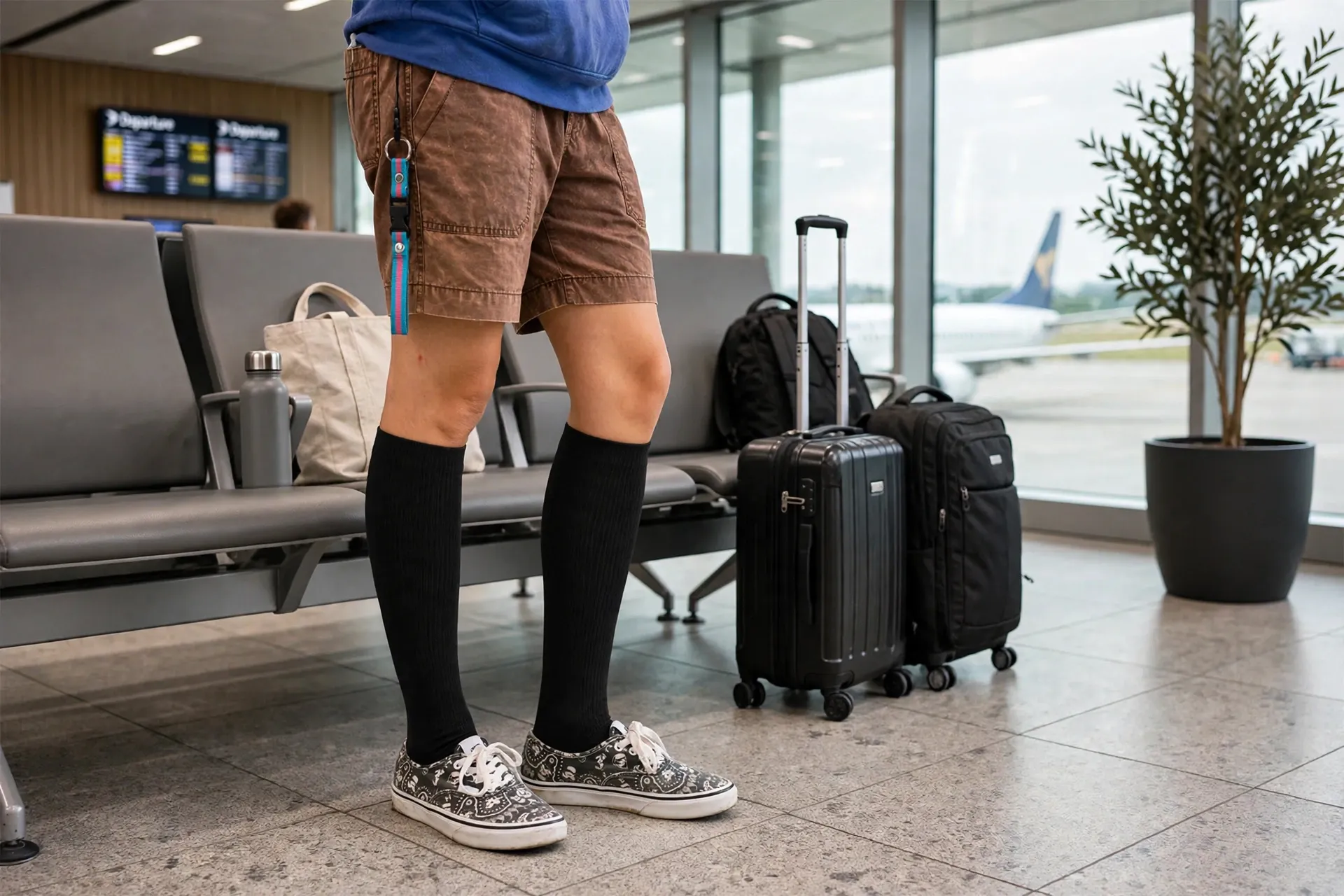
A long journey is mostly sitting still: hours in an aeroplane seat, a train carriage or a car, with little room to move. By the time a traveller lands, ankles may feel swollen and calves stiff. For a buyer sourcing a travel range, that is the use case to design around — a sock that actually gets worn for a full travel day.
This guide is for private-label buyers, distributors and brand owners sourcing travel compression socks. It is a buying guide, not medical advice: where a traveller has a circulation condition, a recent operation, a history of blood clots or is pregnant, the choice of compression level needs professional guidance.
1. Start with the journey, not the sock
Before comparing products, name what the trip involves: a long-haul flight means four hours or more seated in a confined space, so easy on and off matters; a long train or coach journey has similar sitting time but more room to move; on a long drive the driver cannot walk around at all between stops, so the sock must not dig in behind the knee or at the top band; a journey with connections adds walking between terminals and carrying luggage, then sitting again. A range that has to cover all of these needs one sock that works across them.
2. What travel compression socks can — and cannot — do
Get this right before any product decision: it affects the labelling as well as the buying. Graduated compression socks apply pressure firmest at the ankle and gradually lighter up the calf. For most healthy travellers, that gentle squeeze can help legs feel less heavy and reduce the swelling from sitting still for hours. That is the claim to stay inside — comfort and reduced swelling after long sitting, nothing more — and the product description, packaging and travel guidance should all say the same thing. No prevention claim should be added without a proper basis. Anyone with a diagnosed circulation condition, a recent operation, a history of clots, or who is pregnant should ask a clinician which level, if any, is right for them.
3. Compression level: ask for the document behind the number
Compression is usually stated as a pressure figure, firmest at the ankle and lighter up the calf. The figure is only as good as the document behind it, so two questions matter more than the headline number: is the compression graduated, and has the stated level been tested for that exact product and size? Ask for the test method and report — method, issuer and date — rather than accepting a label at face value. A figure copied from a catalogue, a different construction or a different size is not evidence, and the same applies to any material or cooling claim.
4. Fit and sizing: measure, do not guess
A sock in the wrong size is worse than no sock at all — too loose and it slides down, too tight and it cuts in over hours of sitting. Check that the size chart is based on measurements, not only shoe size or S/M/L: ankle circumference above the ankle bone, calf circumference at the widest point, and calf length to just below the knee, so the top band does not dig in when seated. Check the ends of the range, not only the middle, and ask for fitting samples in the smallest and largest sizes. A fitting sample in each size, tried through a full day, is worth more than a size chart alone.
5. Fabric, comfort and easy on/off
A travel sock is only useful if it stays on for the whole journey. Check breathability after hours of wear, flat seams with no hard edge at the top band or toe, and a reinforced heel and toe so the sock survives repeated washing. Ask whether a zippered version is available and what the trade-off is — a zipper helps with fitting, but it changes the seam, the wash care and the feel, and it must lie flat enough not to press against the leg when seated. Wash the sample several times before deciding: a sock that loses its hold after a few washes will generate returns across the whole range.
6. What to ask an OEM supplier
Use this checklist before ordering. It does not state Aby-Tex's MOQ, price or lead time — confirm those for the specific order.
- What compression levels and size ranges can you supply, and what test reports support them?
- What yarn blend and knit construction is used, and can you provide a composition statement for this exact product?
- Is a zippered version available, and how does it differ in fit, care and durability?
- Can you supply a fitting sample in each size, and what is the sampling process? (Aby-Tex states a 7-day target for custom sampling — confirm the timeline for your design.)
- What customisation is available: length, colours, logo, packaging and labelling, including travel-retail branding?
- How is quality controlled — and what happens if a batch does not meet the agreed specification?
- What are the care instructions, and how many wash cycles is the product expected to withstand?
Pricing depends on yarn, construction, size range and order quantity — see Choosing a custom compression sock manufacturer for the sourcing picture, and How to Launch a Private-Label Compression Sock Brand on Amazon for the private-label side.
A simple way to decide
List the journey first, then the compression level with a test report behind it, then the size from real measurements, then a fabric tested through a full travel day and several washes. If a supplier cannot answer the checklist with documents and samples, the sock is not ready for your travellers.